

The roof of the Fort York Armoury is a barrel vault constructed entirely of wood. Its parabolic shape enables it to carry load with maximum efficiency. The structural system, commonly referred to as a lamella roof, consists of main members that span from one side of the vault to the other in two diagonal directions, thus forming a rhombic pattern. This arrangement allows the relatively slender members to act together, endowing the system with greater stiffness and stability than would be possible if the members all spanned along the shortest path.
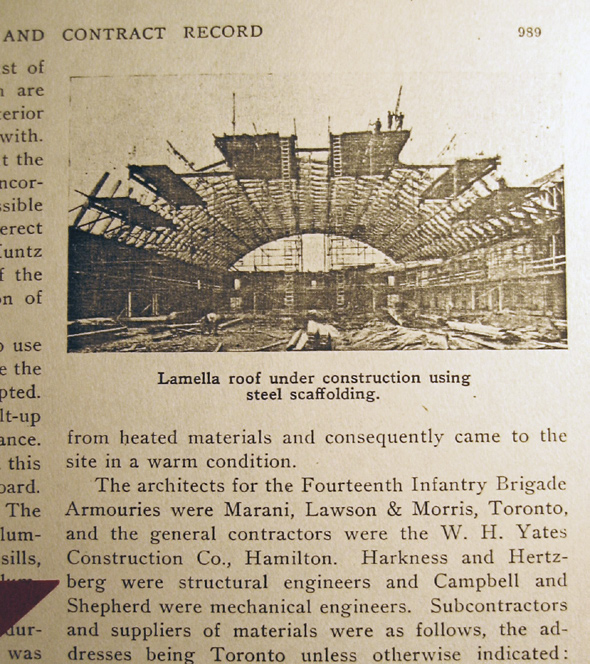
This type of structure has been built in all of the major construction materials. The Italian engineer Pier Luigi Nervi, for example, designed several concrete lamella roofs for airplane hangars in the 1930s and 40s [1]. The system for constructing lamella roofs entirely of timber was invented and patented by the German Friedrich Zollinger in the 1920s [2]. His insight was to arrange the primary members such that exactly one of them was continuous across each corner of every diamond. This resulted in a simple, standard joint detail and enabled large roofs to be assembled from relatively small and light beams that could easily be handled by workmen on site without heavy equipment. This is confirmed by the photograph of the Armoury roof during construction, which shows the structure being erected using only a relatively simple scaffolding that was advanced as the work progressed and, significantly, no large crane.
A distinctive feature of timber lamella roofs is their woven appearance. Along a given line of beams, the members appear to pass alternately under and over the members they intersect at the joints. This is a result of the shape of the individual beams, which are deeper in the middle than at the ends. The detail originates not from a preconceived architectural preference, but rather from the need to maintain the structural integrity of the beams as they pass through the joints. The Zollinger system connection requires that one or more holes be drilled through the middle of each member. Making the beams deeper in the middle enables these holes to be located away from the lower half of a given member, thus minimizing their impact on the capacity of the member to resist bending.
The roof of the Fort York Armoury stands out among other lamella roofs in several regards. Anecdotal evidence supports the claim that its clear span of 37.69 m (123 ft 8 in) is the longest in the world for this type of roof. It is certainly longer than the 36.36 m span of the Halle Münsterland (Germany), which was identified by German engineers as the longest spanning timber lamella roof [3]. The connection details used in the Armoury roof are different from the standard details of the original Zollinger system. The latter detail, which was used at Halle Münsterland, connects three beams using only one set of bolts. This connection is relatively simple to execute but does not enable the members to intersect at a common point. It creates an indirect load path and increases the flexibility of the system. For the Armoury roof, the connections incorporate steel splice plates which permit the members to intersect at a common point. Simplicity of construction is not adversely affected. The Münsterland roof required extensive rehabilitation in the 1980s to correct large deflections that developed over time. The Armoury roof, however, has performed well over its entire life. This may be related to the greater stiffness and structural efficiency of its connections.

The structural engineer of record for the Fort York Armoury was the Toronto firm Harkness and Hertzberg [4], one of whose partners, Charles S. L. Hertzberg, was also a military man of considerable renown [5]. It is unlikely, however, that the lamella roof was designed by this firm. The roof was a proprietary product furnished by licensee Lamella Trussless Roofs (Ontario) Ltd. of Toronto [6]. Actual construction of the roof was done by E. P. Muntz Ltd. of Hamilton [4]. (Eric Percival Muntz, a 1914 civil engineering graduate of the University of Toronto, was a talented engineer in his own right who was active as both a designer and a builder. He was granted several patents for inventions, including a system for constructing prestressed concrete members [7].) In the US and Canada, rights to the Zollinger patent were held by Lamella Roof Syndicate, Inc. of New York, which acted through independent local licensees operating under some variation of the name Lamella Trussless Roofs [8]. In the case of another major Zollinger lamella roof, the Houston Convention Hall, design was done in New York by Wilhelm Klingenberg of the Lamella Roof Syndicate. It is likely that the design of the Armoury roof originated from the same organization.


It is unfortunate that we do not know the name of the engineer who designed this magnificent roof. The clean, efficient connection details and probable record span are evidence that this was an individual of considerable technical talent. The structural system he designed creates one of the most visually compelling spaces in Toronto.
Sources & Further Reading
1. Nervi, Pier Luigi. Costruire correttamente. Milan: Editore Ulrico Hoepli, 1965.
2. Winter, Klaus and Wolfgang Rug. “Innovationen im Holzbau – Die Zollinger-Bauweise.” Bautechnik 69 (1992): 190-97.
3. Kreißig, E. and J.-J. Niemann. “Tragverhalten eines holzernen Zollbau-Lamellendaches am Beispiel der Halle Münsterland.” Bautgenieur 58 (1983) 277-84.
4. “Lamella Type of Roof with Largest Lamellas Ever Used.” Engineering and Contract Record 48 (1934): 987-90.
5. “Hertzberg, Charles S. L.”, St. Andrew’s College, accessed June 20, 2012, http://kilby.sac.on.ca/activitiesclubs/cadets/history/militaryoldboys/wwi/HertzbergCharles.html.
6. “The Lamella Roof.” (Advertisement) Engineering and Contract Record 48 (1934): 986.
7. Muntz, Eric P. “Pocess of Making Prestressed Reinforced Concrete.” US Patent 2,413,990 filed January 25, 1943 and granted January 7, 1947.
8. “Building Houston’s Great Convention Hall.” Engineering News-Record 100 (1928): 815-17.
Original printed pages


