The gift to the Friends of Fort York of Charles Pachter’s giclée portrait of John Graves Simcoe in 2008 made me begin to think about the thirty Simcoe likenesses I’ve seen, as prints, in watercolour and oil, and as medals and statues. Three of these are generally accepted to be rendered accurately, at three significant moments during his life.
The earliest portrait was commissioned when Simcoe was in his early 20s from the English painter William Pars (1742-1782). It depicts him as an ensign in the 35th Regiment of Foot and may have been painted to document his appointment, or just prior to the Regiment’s dispatch to America in 1775. The next, and with the strongest ties to Toronto, is the Queen’s Rangers portrait by the French painter Jean Laurent Mosnier (1743-1808). Commissioned in 1791, it celebrates Simcoe’s appointment as the first lieutenant governor of Upper Canada. Both of these are well documented in the Christie’s auction of paintings from Wolford Lodge, the Simcoe home in Devon, in 1922. Both were purchased by the same dealer (Frank Sabin), sold to the same client (Robert Harmsworth), and ultimately donated by him to two separate Toronto collections (University of Toronto and the Toronto Public Library).
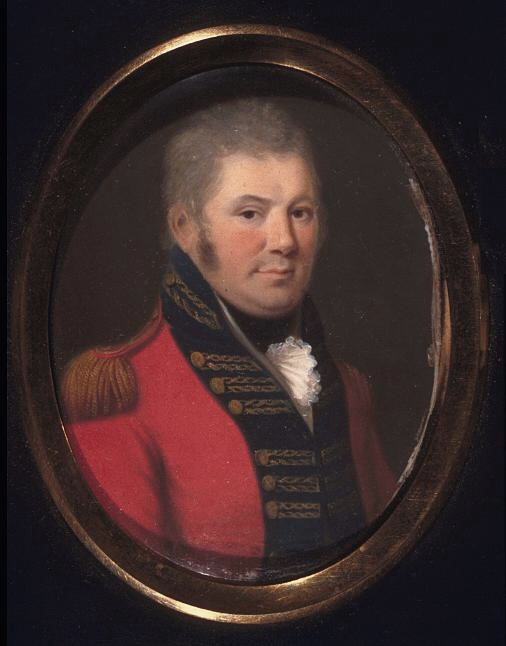
The final work, and the subject of this essay, is intriguing because all of us know it, yet few, if any, of us have laid eyes on it. It is a miniature now in the collection of the McCord Museum in Montreal, with Simcoe shown in the scarlet uniform of a lieutenant-general. In 1796, he was given this as a local rank when he was governor of St. Domingo (Haiti); the rank was confirmed in the British Army in 1798. Given this sequence the anonymous miniature must have been commissioned sometime close to the latter date.
At this point the miniature (and the likeness) begins to take on an interesting life of its own. In a letter dated 18 April 1812, the English sculptor John Flaxman (1755-1826) acknowledges receipt of a miniature allowing him to complete Simcoe’s monument in Exeter Cathedral. Flaxman uses this image for the central portrait in the memorial. The miniature appears again in the possession of the Toronto historian and Simcoe family friend, the Reverend Henry Scadding (1813-1901). We know this because George Theodore Berthon (1806-1892) used it as the basis for his Portrait of John Graves Simcoe in General Officer’s Uniform, painted in 1881 for the Government of Ontario Art Collection. John Wycliffe Lowes Forster (1850-1938) and Edmund Wyly Grier (1862-1957) both used it for their oil portrait interpretations of the heroic Simcoe. This image inspired a lithograph attributed to the American engraver Henry Howe (1816-1893) in 1880 and an engraving by the American Bank Note Company in 1890. The 1892 Upper Canada Centennial Commemorative Medal, created by the Toronto medallists Ellis Company, utilizes it as the quintessential Simcoe likeness, as does Walter Seymour Allward’s (1876-1955) bronze sculpture in Queen’s Park, unveiled in 1903. The miniature eventually enters the collection of the famous Canadiana collector and dealer John L. Russell (died in 2003) who sold it to the McCord Museum in 1966. Another “red Simcoe” by William Cruickshank (1849-1922) in the collection of the York Club in Toronto is a more imaginative than historical vision of the general and is ultimately unrelated to the progression of likenesses based on the miniature.

This sea of red Simcoes does beg the question: why does the post-Upper Canada likeness come to dominate our visual landscape and not the green Queen’s Rangers likeness by Mosnier? I think the answer is simple. It was available. Scadding had the miniature in Toronto, and the scarlet uniform resonated with the popular belief of what he should have been wearing. The Mosnier portrait does not emerge from Simcoe’s descendants until Christie’s 1922 sale and only arrives in Toronto in 1927.
Throughout this essay I’ve referred to the Scadding-Russell-McCord miniature as the primary source image for all these later derivative works. But was there a life-sized oil painting contemporary with the miniature? I believe it existed and may still exist, unidentified in a public or private collection. I have three reasons. First, the Mosnier portrait is known in both the life-sized oil and as a contemporary miniature. If Simcoe had his appointment as lieutenant governor of Upper Canada commemorated with both an oil and a miniature, why wouldn’t he do this for his more prestigious appointment as lieutenant-general as well? Second, the collection at Wolford Lodge was broken up at least twice as Simcoe’s estate is divided over time. Objects have continued to come to the market from descendents as late as the 1990s, and others may have been sold privately. Finally, in a clipping from the Toronto Telegram regarding the auction of the contents of Wolford Lodge in 1922, there is a note regarding the sale of two family portraits of Simcoe, one at age 21 (certainly the Pars portrait) and another in a scarlet uniform circa 1800. The Pars portrait is listed in the Christie’s catalogue; the other is not. The search continues.
Original printed pages