On 6 December 2010, Fort York National Historic Site in association with the Friends of Fort York, as part of the Parler Fort series, was pleased to host a book launch for Dorothy Duncan, author of Feasting and Fasting: Canada’s Heritage Celebrations. Dr. Carl Benn, former curator of Fort York and now Chair of the Department of History at Ryerson University, joined us in honouring Dorothy for this newest work and for her long association with the fort, which he recalled in some remarkable anecdotes of her early years.
Dorothy Duncan was preceded over the years at Fort York by many other cooks. One of the earliest references we have is Mrs. Chapman, best remembered for her reluctance to evacuate the garrison in the face of an American invasion during the battle of York in 1813. Apparently, she was a truly dedicated cook and one can only wonder what was on the menu that day. A little more than 150 years later the fort welcomed another dedicated cook to develop museum programmes that would help tell the story of the people who lived at the garrison. That cook was Dorothy Duncan and she was instrumental in the birth of the successful Fort York Foodways Programme.
Brigadier John McGinnis, managing director of the Toronto Historical Board, was familiar with the food programmes implemented by Duncan at Black Creek Pioneer Village. In 1968 he hired her as curator of Historic Houses. At that time none of the houses or the fort was delivering any heritage food interpretation. Duncan’s first task was to research and develop a programme for Fort York. This request was prompted by new structural clues that had been uncovered revealing that not only was there a kitchen in the basement of the Officers’ Mess, but also one on the main floor. Restoration of this kitchen included the hiring and training of historical interpreters Ruth Keene and Jean Lomas. Brigadier McGinnis invited the mayor and city council to preview the new Officers’ Mess exhibit and asked Duncan to provide a luncheon for each of the two days they would be visiting. Helen Gagen, food editor of the Telegram, described the bill of fare: “prepared on the hearth and in the newly restored brick oven, including ham glazed with dry sherry, ginger and celery seeds; scalloped potatoes; old fashioned relishes, green salad with a hot mustardy dressing, homemade bread and butter; Indian pudding with hot rum sauce, cider, black and green tea.”
The success of these luncheons sparked further expansion. Duncan developed popular cooking classes for the public at both Fort York and Mackenzie House called, “If You Can’t Stand the Heat…Stay out of the Kitchen.” The expanding programme at the fort included daily animation of the kitchen with a fire in the hearth, biscuits on the griddle, meat roasting in the reflector oven, and yeast making from hops and potatoes.
These early initiatives laid the foundation for our current Foodways Programme. With food as a tool in the interpretation of history, we are still telling the story of the people who once lived at the fort by offering cooking classes, animating the Officers’ Mess kitchen for special events, and developing historical recipes. Today most of this work is carried on by a loyal group of Volunteer Historic Cooks.
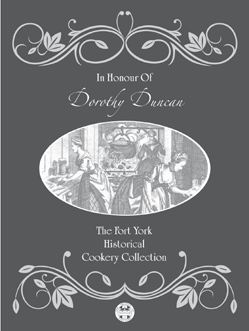
In recognition of Dorothy Duncan’s dedication to the fort over the years, Fort York and the Friends of Fort York have created an honorary cookbook collection: the Fort York Historical Cookery Collection which consists of primary source cookbooks from the late 18th and early 19th century, as well as relevant secondary source food history books. Stephen Otto, a director of the Friends, presented Dorothy with a framed bookplate that will be used to distinguish books in the collection. Publisher Dundurn Press added congratulations by donating a copy of each of Duncan’s books to the collection.
Her friends and colleagues agreed that it was an honour to mark the contributions Dorothy Duncan has made to Fort York National Historic Site as well as to Canada’s food heritage.
A recipe from Dorothy Duncan’s Feasting and Fasting: Canada’s Heritage Celebrations (Dundurn Press, 2010), pp 87-8.
(This recipe is similar to the Derby Cakes recipe from The Cook Not Mad; or Rational Cookery, 1831, that the Fort York Foodways Programme often uses when baking on the griddle by the hearth fire.)
Welsh Cakes
Dorothy attributes this recipe to the late Dorothy Grove of Toronto who brought her favourite Welsh Cake recipe with her when she left Wales for Canada in the twentieth century.
2 cups flour
1 teaspoon baking powder
½ cup sugar
2/3 cup lard
1 egg
½ cup currants
½ teaspoon salt
½ teaspoon allspice, nutmeg, or mace
1 teaspoon vanilla
Mix all ingredients well, roll out about ¼ inch thick, cut into circles, and cook over medium heat in a greased cast-iron frying pan until brown on both sides.
Original printed pages