

With roots in this city extending back over two hundred years, the Cawthras come close to being a founding family of Toronto. Joseph Cawthra (1759-1842) arrived here in 1803 or 1806, set up an apothecary shop and then brought his family over from England. He became a mercantile success story; in 1873, Henry Scadding wrote of “the great wealth (locally proverbial)” of the Cawthras. This prosperity arose from the War of 1812, when Joseph amassed profits by selling supplies to the British army.
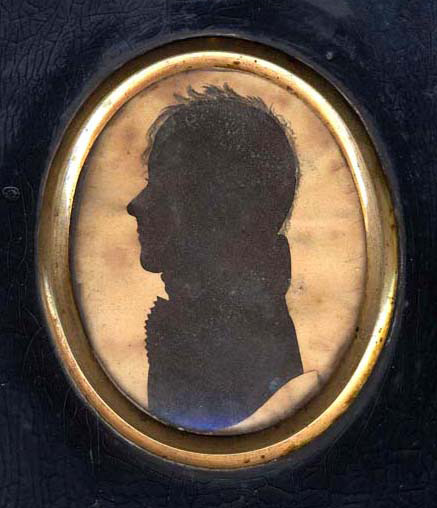
The Cawthra story to be told here concerns the War of 1812, but is not about Joseph’s business acumen (or his medical aid to the Battle of York’s wounded). The focus is on his sons Henry (1787-1854), Jonathan (1791-1868), William (1801-80), and especially John (1789-1851), and their involvement in the conflict. Thanks to a generous gift from Anne Coneybeare, a Cawthra descendent, City of Toronto Museum Services has acquired three artifacts–a medal, a sword, and a silhouette–which relate to John and possibly his brothers.
As war clouds gathered over the town, John tried to get a commission in the York militia. Due to his father’s unpopularity with the Upper Canada establishment, he instead enrolled as a private in Capt. Duncan Cameron’s Company of the 3rd Regiment of York Militia. He was at the York garrison on 30 June 1812, then volunteered to join Major-General Isaac Brock’s attack on Detroit in mid-August. He fought again with Brock at Queenston Heights, helping Brock’s dying aide-de-camp, John Macdonell, from the battlefield.
At least two of John’s brothers also figured in the war. Jonathan was a private in the same flank company as John and served with him at Queenston Heights. Young William witnessed the coming of the U.S. fleet in April 1813; he helped pull ropes up the Fort York flagstaff used to signal the battery at Gibraltar Point, until American cannon fire prompted him to scamper home. (Henry, who suffered a serious head injury as a child, receives little mention in family records.)
What is the connection between the brothers and our newly acquired artifacts? The Military General Service Medal with Fort Detroit clasp has its edge stamped “J. CAWTHRA. CANA’DN MILITIA” and is clearly John’s, marking his service at Detroit. This campaign medal was approved in 1847 for issue to officers and men of the British army for military actions between 1793 and 1814. As it was only awarded to surviving claimants who applied for it, John’s medal dates from some time between 1847 and 1851, when he died a merchant at Newmarket.
The sword is a key part of Cawthra family lore. Dating from the early 19th century, it is said to be a trophy taken at Detroit by John following Brock’s victory. The sword itself is curious. It features an unusual medusa- or gorgon-headed pommel, and does not follow approved British or American military or naval patterns. Possibly it is of English manufacture for the American market or the fur trade. Who carried it before John remains an open question.
The silhouette is equally intriguing. Three Cawthra silhouettes are known. Each depicts a young man wearing a high collar and lace cravat, facing left, and all seem to be cut by the same hand. Two appear in printed family histories, where they are said to be of John and his father, Joseph. The third, now added to the City’s collection, is unmarked. If the printed histories are correct, could ours be of Jonathan, or even Henry or William? Perhaps silhouettes were made of the three older boys (and not their father) at the outset of the war, once at least two of them had decided to join the militia. Alternatively, given that our three artifacts have been carefully kept together for decades, our silhouette may represent John Cawthra.
Taken together, the Cawthra artifacts give us a new view of York’s role in the War of 1812. The story is neither about Fort York nor the town’s invasion and defence–no Cawthra is on any militia list relating to the Battle of York. Instead, we think of how York’s men marched bravely away to fight battles in other places, and how mementoes tie us to people and events.
Original printed pages


