The public opening of the Royal Ontario Museum in March, 1914, was the culmination of almost a century of efforts to establish a provincial museum in Toronto. The most comprehensive, ambitious and tragic of these was Charles Fothergill’s plan to develop a publicly-funded museum in the 1830s. Fothergill made significant contributions to the cultural, political and entrepreneurial enterprises of the young city but is now remembered as one of Canada’s first ornithologists.
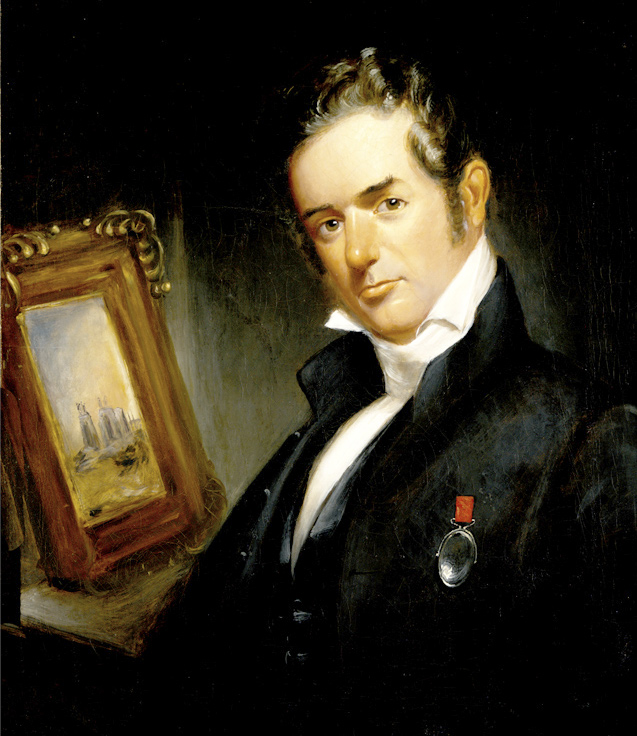
Charles Fothergill was born in York, England in 1782 into a distinguished Quaker family that had made significant contributions to art, medicine and science. His father, an ivory and comb manufacturer, was the nephew of the eminent physician, naturalist and philanthropist, Dr. John Fothergill (1712-1780). His mother was the sister of the renowned artist and traveller, James Forbes FRS (1749-1819), whose four-volume Oriental Memoirs documenting seventeen years of studies of the culture, flora and fauna of India was published in 1813.
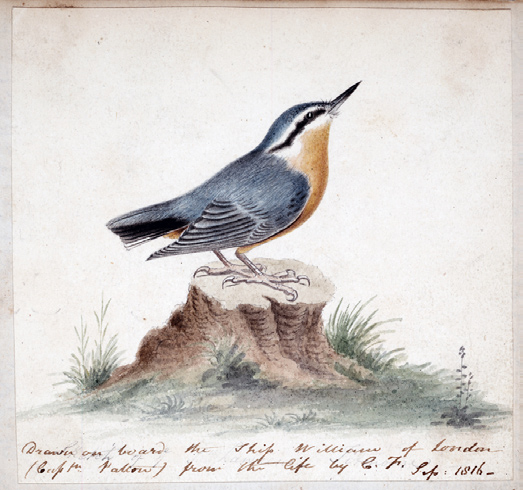
Fothergill was drawn to the study of natural history, particularly ornithology, from early childhood. At the age of seventeen he published Ornithologica Britannica, an eleven-page folio listing 301 species of British birds. As a young adult, Fothergill rejected his father’s trade, pursuing various careers and entrepreneurial ventures with little success. In 1804, he moved to London to pursue a short-lived career as a stage actor but was soon disappointed that there were few opportunities in the theatre world. Throughout 1805 and 1806 he travelled to northern Yorkshire as well as the Orkney and Shetland Islands to prepare a publication about the birds of the northern isles of Britain. Although he had engaged the noted engravers Thomas Bewick, Samuel Howitt and John Thurston to illustrate this work, only his introductory Essay on the philosophy, study, and use of natural history was published in 1813.
After his marriage to Charlotte Nevins in 1811, Fothergill began studying medicine in Edinburgh but soon thereafter was forced to flee to the Isle of Man to escape creditors. Here he turned to farming, but his investments were destroyed by the collapse of agricultural markets after the Napoleonic Wars. These financial problems eventually led to his decision to emigrate and in July, 1816, Fothergill sailed to Canada with his wife and their two infant sons. In 1817, he settled in Smith’s Creek, Port Hope, where he opened a general store and became the first postmaster of the village. By 1821 he had opened a brewery and distillery in Port Hope as well as a saw mill and grist mill at Scott’s Mills.
Throughout his years in Upper Canada, Charles Fothergill played an active part in local politics. He was a member of the Land Board and a Magistrate of the Court of Requests. He served as King’s Printer of Upper Canada from January 1, 1822 to January 31, 1826, publishing the only official government paper, the Upper Canada Gazette. In 1822, he started an unofficial newspaper, the Weekly Register, and in its May 30, 1822 issue, published the first nature column to appear in any Canadian newspaper. His wife and an infant son died in 1822 while Fothergill himself contracted a lingering illness; in 1825 he married Eliza Richardson of Pickering.
In 1824, he was elected to Parliament, campaigning under the motto “AGRICULTURE and INTERNAL IMPROVEMENT, without the aid of those who EAT more than they EARN.” During the session of 1825-26, Fothergill was recognized as a leading member of parliamentary opposition.
It was once said of Charles Fothergill that he “had every sense but good sense.” Although he voted against the administration on a number of occasions, Fothergill was equally critical of William Lyon Mackenzie, branding him a “crack-brained demagogue” and “a caterer of loathsome food for depraved appetites.” His financial extravagances and high charges for printing, along with political reasons, led to Fothergill’s dismissal from his position as King’s Printer in 1826.
Throughout these difficult times, Fothergill remained committed to the study of natural history. In 1830, he petitioned the governments of Upper and Lower Canada, the Hudson’s Bay Company, the Natural History Society of Montreal and the Literary and Historical Society of Quebec to fund a three-year expedition to the Pacific Coast to explore the possibilities of settling the West and to study the natural resources en route. He continued his own studies of the unique animals of Upper Canada and in 1830 was awarded a silver medal by the Natural History Society of Montreal for his An essay descriptive of the quadrupeds of British North America. His essay about the dangers facing the Lake Ontario salmon fishery was read at the Literary and Historical Society of Quebec in 1835.
Nor was his commitment to art ignored. In 1834, Fothergill joined the Society of Artists and Amateurs of Toronto founded by John G. Howard. Among the thirteen associates of the Society were Paul Kane and Captain (later Sir Richard) Bonnycastle. Fothergill contributed ten watercolours of English birds, scenery, plants and fishes for the Society’s inaugural exhibition.
In 1831, Fothergill together with Drs. William (Tiger) Dunlop and William Rees formed the York Literary and Philosophical Society to “investigate the natural and civil history of the colony and the whole interior as far as the Pacific and Polar Seas, throughout the Animal, Vegetable and Mineral Kingdoms, also to promote the study of Natural History, Natural Philosophy and the Fine Arts.” The Society, conceived partly as a museum, was interested in collecting the records of “the aboriginal cultures.” However, it faced competition from its inception: at the same time, a Mechanics’ Institute was set up in York with the intention of building a public library and to promote the “diffusion of useful knowledge by means of lectures and experiments.” The inaugural address of the Society was delivered by Rev. Dr. Strachan but it collapsed in 1833.
Despite the collapse of the Society or perhaps because of it, Fothergill was determined to establish a museum in Upper Canada. The establishment of a Toronto museum had the potential to combine Fothergill’s passion for natural history with his need to provide a sound financial footing for his growing family. Fothergill’s 1823 visits to Peale’s Museum in Philadelphia and Scudder’s Museum in New York City had provided him with proof that museums could be profitable ventures. In 1810, more than 33,000 visitors (the equivalent of one-third of the population of Philadelphia) had visited Peale’s Museum. Although Peale’s and Scudder’s museums were privately owned, both enjoyed rent-free premises thanks to government support. Fothergill hoped to minimize his expenses and increase his chances for success by petitioning for a publicly-funded museum in Toronto.
In April, 1835, Fothergill published an address announcing his hope to establish a Lyceum of Natural History and the Fine Arts in Toronto. It was a disgrace that the provincial capital had no museum, when every American city boasted one. He announced the appointment of a curator of the new facility, an unnamed individual who had extensive experience in the museum world, having worked at Peale’s museum in New York and at the British Museum.
Fothergill assured the public that he had already acquired collections of: “Several hundreds of well preserved specimens of Natural History; of Quadrupeds; Birds; Fish; Reptiles; Insects; Shells; Fossils; Minerals; Vegetables; &c &c., and a few good PICTURES, and other valuable subjects of VERTU. Are already in store for exhibition in the proposed INSTITUTE; quite sufficient to make a respectable beginning…”
He was most interested in acquiring natural history specimens, particularly those native to British America. Collectors were encouraged to donate their specimens outright or place them “in temporary deposit” with the assurance they could be withdrawn at any time. In an effort to entice donors, Fothergill offered to display donors’ names prominently and to feature their names in a museum catalogue to be published at a later date.
Fothergill praised the study of nature as “The Book of Nature is opened only in all its magnitude and power to the clear and intellectual head and to the uncorrupted heart; – to the foolish and sordid, or the utterly dissipated, it is as a treasure hermetically sealed; and all that is vast and comprehensive in design, and excellent in contrivance, and admirable in arrangement; and all that is most beautiful or interesting in united simplicity and grandeur in the widely extended scenes which surround us, must to the uninitiated, remain forever in obscurity or utter darkness.”
Until a suitable building could be custom built, Fothergill had engaged “commodious” rooms in the centre of Chewett’s Buildings, near the British Coffee House on King Street. A picture gallery and portraits of eminent individuals would form a part of this institution. In describing the mandate of the Lyceum Fothergill turned to Sir William Jones, proclaiming that it be dedicated to the study of “MAN and NATURE, whatever is performed by the one, or produced by the other!”
Fothergill’s emphasis on natural history as the foundation of the museum collection seems unusual to twenty-first-century museum goers. However, it was typical of most North American museums of the nineteenth century. Unlike their European counterparts, North American museums had no reminders of an illustrious past. The lack of artistic traditions and mistrust of art as a decadent luxury further limited the scope of these early collections. While many public museums in Europe were created from the collections of monarchs, early North American museum owners had to establish their own collections. These early collections represented a world which was curious and eager to see the objects and peoples encountered in a period of ever-expanding military, exploration and settlement. As the continent was mostly uncharted, and much of its flora and fauna were as yet not described scientifically, natural history specimens were of interest to foreign visitors and settlers alike. An additional factor influencing these collections was the rapid disappearance of many species as settlement encroached upon their habitats. But there were also pragmatic reasons to highlight natural history: not only could natural history specimens be acquired readily by hunting, but a thorough knowledge of a nation’s natural resources could contribute to the advancement of its economic potential.
In January, 1836, Lieutenant Governor Sir Francis Bond Head surveyed the Garrison Common. Fothergill introduced himself to Bond Head in a letter dated June, 1836. He requested land either on the military reserve adjacent to Fort York or in Toronto itself to be the site of his proposed institution. Fothergill’s request was referred to the Chief Ordnance Officer in Toronto, Captain Rickard Bonnycastle, for a report. In August, Fothergill again wrote to Bond Head, requesting four to five acres to accommodate the botanical and zoological gardens now included in his proposal. Bonnycastle, a supporter of science (he had proposed the construction of an astronomical observatory in the city in 1836), recommended a grant of only two acres on the military reserve suggesting two more acres when the reserve was laid out in streets. Fothergill noted that this was too small to accommodate his new plans.
William Rees, who had also unsuccessfully petitioned for public funding for a museum in 1835, wanted to join Fothergill in this venture but his offer was rejected. Fothergill wanted the venture to be his alone as he had suffered “very foolish and prodigal expense” in assembling his collection.
Confident that the grant was forthcoming, Fothergill issued a revised prospectus for the Lyceum on December 13, 1836. While it re-iterated most of his earlier hopes for the project, Fothergill now announced that he was creating a repository for specimens “that might otherwise be lost or which are so widely scattered amongst private individuals as to be but of little service to the advancement of science in this country.” He used the address to announce that a piece of ground at the west end of the city had already been surveyed and would be the eventual site of the necessary buildings.
As interest in Phrenology and Comparative Anatomy was developing, Fothergill asked that appropriate specimens illustrating these subjects be submitted. As well, geological specimens were requested. Of particular interest were “those fossil remains which show us, beyond controversy, what manner of beings have sported upon, and what vegetables have clothed a former world – upon the remains of which we now live, move, and philosophize.” The Lyceum would now include Botanical and Zoological Gardens as these had proved extremely popular in London and other large English towns.
A Picture Gallery would be created “especially for subjects connected with Science, and Portraits of Individuals.” Lastly, Fothergill appealed for “INDIAN ANTIQUITIES, ARMS, DRESSES, UTENSILS and whatever may tend to illustrate, and make permanent, all that we can know of the Aborigines of this great continent; a people who are rapidly passing away, and becoming as though they had never been; who are, indeed, with all their striking characteristics of stirring interest, vanishing like a vapour from the face of the earth, and whose very history, if we do not immediately attempt to preserve what yet remains, will be lost in forgetfulness…”
Fothergill encouraged Communications about the institution while specimens were to be directed to “commodious rooms engaged in the city.”
Fothergill’s revised prospectus reflects his knowledge of museum trends throughout North America and England. Early nineteenth-century museums sought to recreate the world in miniature and were repositories for every art and science. They revealed the boundlessness of nature and of God’s creation while celebrating human achievements in taming the natural world. As products of Enlightenment thinking, they proclaimed the unity and utility of knowledge. In an era when print lithography was too costly to mass produce pictorial images and when international travel was dangerous and too costly for the average citizen to consider, nineteenth century collections offered their visitors glimpses of the past and of the vastness of nature. But museums also competed with popular education movements, such as mechanics’ institutes. Lectures, scientific demonstrations and even artifact collections were prominent features of this movement. As a result, reliance upon science and edification was insufficient to ensure the longevity or appeal of many museums. In the absence of government or philanthropic support, museums relied upon ticket receipts to survive. Special presentations were critical to their financial stability. By the late 1820s, live entertainments, both human and animal, were featured regularly in proprietary museums along with scientific specimens. Fothergill’s inclusion of a zoological garden was consistent with his desire to create a sheet of water, possibly in the shape of Niagara Falls, was consistent with current museum practice and demonstrated his interest in appealing to the greatest number of visitors.
Shortly after the publication of the second prospectus, Fothergill petitioned the legislature for a grant or loan of £2000 to assist with the construction of the building. On January 20, 1837, the Select Committee report submitted by Allan MacNab recommended that Fothergill’s petition be supported. MacNab noted that Upper Canada had no comparable museum and that the strength of nations depended on an accurate knowledge of their natural resources. Private individuals willing to establish public institutions were to be encouraged as merely a loan was requested. MacNab concluded that the completion of a museum would be an ornament to the city and a credit to the province.
The report documented the existing collection, noting that it included “nearly all the birds, and most of the quadrupeds, known to the Canadas, with many fish, reptiles, insects and shells; a number of the most beautiful birds of South America, with more than forty beautifully colored snakes, the Venom, and one or two small alligators that confirm a very fine specimen of the sharp-nosed Crocodile from the river Ganges, in Asia; a numerous collection of Minerals, Fossils, and Geological specimens. Indian antiquities, Arms, Dresses, & tc, a small but valuable collection of Coins, and about a hundred very choice specimens of Art, by the best masters, both ancient and modern; together with a number of living animals which have been collected and maintained at considerable expense. In all, Mr Fothergill’s contributions amount to nearly two thousand specimens, got together at a cost of certainly not less than £1500.” It was further noted that Fothergill’s collection was “nearly if not quite equal to the original stock of the British Museum.”
The report commended favourably that a number of other donors had come forward with offers to augment Fothergill’s own collection. Captain Bonnycastle had promised 3000 mineral, fossil and geological specimens classed and arranged in scientific order. Major Raines had offered to donate ancient and modern coins. More than 1000 shells from around the world were promised by another donor. Nor was the art gallery to be neglected. An unidentified supporter in England had promised to forward casts from the originals of four of the most celebrated Greek and Roman sculptures: the Venus, Apollo, Gladiator Repellens, and the Hercules as soon as the building was ready. The Literary and Historical Society of Quebec and the Natural History Society of Montreal, organizations familiar with Fothergill, were willing to exchange duplicate specimens.
In view of the contribution these collections would make to the city, MacNab recommended that the sum of two thousand pounds be loaned for a period of ten years without interest. He was optimistic that the establishment could be expected to yield a productive sum within that time. MacNab suggested that the money be invested in the hands of three Trustees: Captain Bonnycastle, Receiver-General John Henry Dunn and Surveyor-General Robert Sympson.
Despite this favourable response, the House did not act upon the report. Fothergill’s recurring gout prostrated him for seven months. When he well enough to resume work, Fothergill discovered that the license of occupation had not been issued and no work had begun.
On July 31, 1837, Fothergill petitioned the Toronto city council for a five-year lease for the “two long rooms up stairs at the south end of the Market Square building, which had been used as printing offices,” as it would take time to design the zoological gardens and construct the building for the Lyceum. He proposed to join the two rooms with a gangway to create a long gallery. An observatory housing “a glass piece of supernal power” was to be constructed at the centre. Fothergill asked that the lease be granted to his son George Alexander Fothergill, who was identified as the curator of the collections.
Fothergill further asked that the rent charged for the space would be moderate so the endeavour would not only benefit the public but would also honour those involved with establishing the enterprise. He hoped that cost he incurred in the renovations would be deducted from the rent as had “been the case in Wm Mackenzie’s.” Fothergill noted that he had contributed significant personal funds to develop the already extensive collection and hoped that his efforts would be rewarded.
Although Fothergill’s petition was submitted in July, it was not referred to committee until early November. There it remained for four weeks but no decision was made. The state of emergency created by the Rebellion further delayed the decision as Council’s proceedings did not resume until a year later.
In the fall of 1837, Fothergill launched his last entrepreneurial venture, a newspaper, the Palladium of British America, and Upper Canada Mercantile Advertiser under his son Charles’ proprietorship. Announcements in the early issues of the Palladium indicated that rooms in the south-west corner of the Market Square buildings were being prepared to house Fothergill’s temporary museum. Later numbers of the paper indicated the tentative location next door to the Palladium‘s office at King and York Streets. However, it is not known whether the temporary museum was ever opened to the public.
Fothergill died suddenly on May 22, 1840, one day prior to his 58th birthday, with his dream of a provincial museum unrealized.
On May 26, Thomas Dalton wrote in the Patriot: “It is well known that Mr. Fothergill had been engaged for many years previous to his disease, in collecting a museum of natural and other curiosities – this collection – the labour of a life – is both instructive and interesting, and we certainly hope that it will not be permitted to be broken and dispersed…A Cabinet of nature and of art is an almost necessary ingredient in the composition of Universites and we could have hope that the present opportunity of forming a Nucleus of a future Provincial Museum, at a very moderate outlay, will receive proper consideration from the Directors of King’s College.”
Samuel Thompson, employed as manager of Palladium until its demise in May, 1839, recalled that Fothergill “was a man of talent, a scholar and a gentleman, but so entirely given up to the study of natural history and the practice of taxidermy that his newspaper received but scant attention…money that should have gone to feed his family was too often spent on odd or strange fish…”
Within days of Fothergill’s death bailiffs seized the family’s property, leaving only the museum collections. The family hoped to open the museum to the public but tragedy soon struck. On June 15, 1840, a disastrous fire by Lucifer Matches set fire to Northcote’s Grocery Store and Ginger Beer Brewery. Strong northwest winds carried the flames upon the premises occupied by Fothergill and quickly engulfed the building. Soon the entire block of buildings at the corner of York and King Streets was ablaze. Most of the businesses affected by the fire were uninsured. The Toronto Patriot reported: “We are sorry to learn of the portion of the Mr. Fothergill’s MUSEUM was destroyed – Mr. Bickerstaff (painter and gilder) is also a great sufferer in the stocks required in his business.”
It is not certain what happened to the remaining collections from the doomed museum. Shortly after the father’s death, George Fothergill wrote to Robert Baldwin Sullivan seeking his help in selling the remaining collections to King’s College. Teaching collections were a standard feature of nineteenth-century Canadian colleges and universities. The Bursar of King’s College, Dr. Boys, examined the remains of the collection and found “it to contain many birds – & being deficient in other branches of natural history. There are 17 glazed cases of specimens of Natural History and other objects of curiosity lying about the room. Of birds there are about 800 specimens Of animals about 60 specimens Of fish and reptiles about 40 specimens There are a few insects; a few shells; some minerals; some birds’ nests and eggs; horns of deer; skulls & bones human and animals; some Indian and South American ornaments; some casts in wax of Indians; three paintings of Indian chiefs; a few gross artificial eyes for specimens of animals and birds; the following books – a presentation copy from Dr. Richardson of the 1st volume of the Fauna Borealis Americana, being the volume on fishes, the American edition of Wilson’s Birds; portraits of Indian chiefs, 12 numbers. The specimens of Natural History are, generally speaking, in good preservation, Most of them require to be properly set up & displayed.”
In the years following Fothergill’s death, the Fothergill family continued its efforts to create a museum on the military reserve near Fort York. On September 20, 1864 Thomas Fothergill wrote to Dr. Rees reaffirming his claim to the land that had been granted to his father. A letter dated April 21, 1864, from the Department of Crown Lands to Quebec ordered “that the grant be forthwith made under the restrictions pointed out by Major Bonnycastle in his Report, the Grant to be for the quantity therein specified, and the rest prayed for, as a License of Occupation only.” It is unlikely that Council ever dealt with his claim. However, in an 1868 letter to the Governor General, William Rees detailed his credentials as a major collector and asked to take over Charles Fothergill’s interests as they had been assigned to him.
Rees’s efforts to fulfil Fothergill’s vision were not realized. In April, 1878, the entire site of the garrison reserve was leased to the city of Toronto for the re-construction of the Crystal Palace for exhibitions purposes associated with the provincial fair. The structure was destroyed by fire in October, 1906.
A fully documented version of this essay will be posted in the History section of the Friends’ website (www.fortyork.ca).
Original printed pages