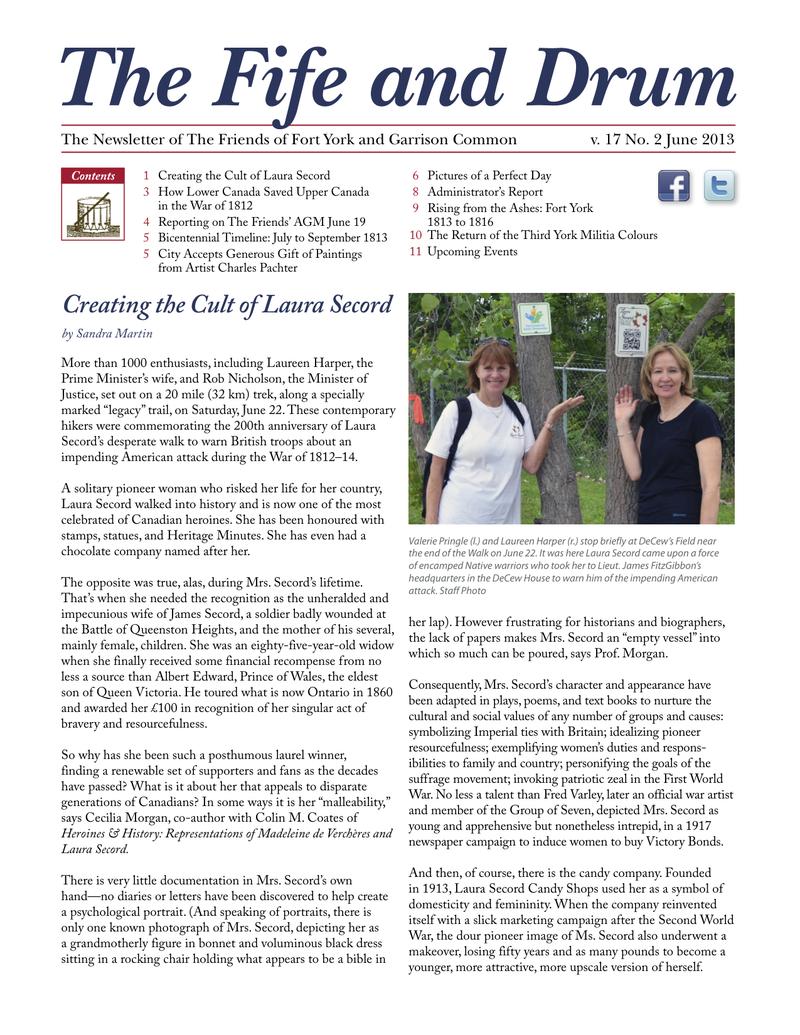
More than 1000 enthusiasts, including Laureen Harper, the Prime Minister’s wife, and Rob Nicholson, the Minister of Justice, set out on a 20 mile (32 km) trek, along a specially marked “legacy” trail, on Saturday, June 22. These contemporary hikers were commemorating the 200th anniversary of Laura Secord’s desperate walk to warn British troops about an impending American attack during the War of 1812–14.
A solitary pioneer woman who risked her life for her country, Laura Secord walked into history and is now one of the most celebrated of Canadian heroines. She has been honoured with stamps, statues, and Heritage Minutes. She has even had a chocolate company named after her.

The opposite was true, alas, during Mrs. Secord’s lifetime. That’s when she needed the recognition as the unheralded and impecunious wife of James Secord, a soldier badly wounded at the Battle of Queenston Heights, and the mother of his several, mainly female, children. She was an eighty-five-year-old widow when she finally received some financial recompense from no less a source than Albert Edward, Prince of Wales, the eldest son of Queen Victoria. He toured what is now Ontario in 1860 and awarded her £100 in recognition of her singular act of bravery and resourcefulness.
So why has she been such a posthumous laurel winner, finding a renewable set of supporters and fans as the decades have passed? What is it about her that appeals to disparate generations of Canadians? In some ways it is her “malleability,” says Cecilia Morgan, co-author with Colin M. Coates of Heroines & History: Representations of Madeleine de Verchères and Laura Secord.
There is very little documentation in Mrs. Secord’s own hand—no diaries or letters have been discovered to help create a psychological portrait. (And speaking of portraits, there is only one known photograph of Mrs. Secord, depicting her as a grandmotherly figure in bonnet and voluminous black dress sitting in a rocking chair holding what appears to be a bible in her lap). However frustrating for historians and biographers, the lack of papers makes Mrs. Secord an “empty vessel” into which so much can be poured, says Prof. Morgan.
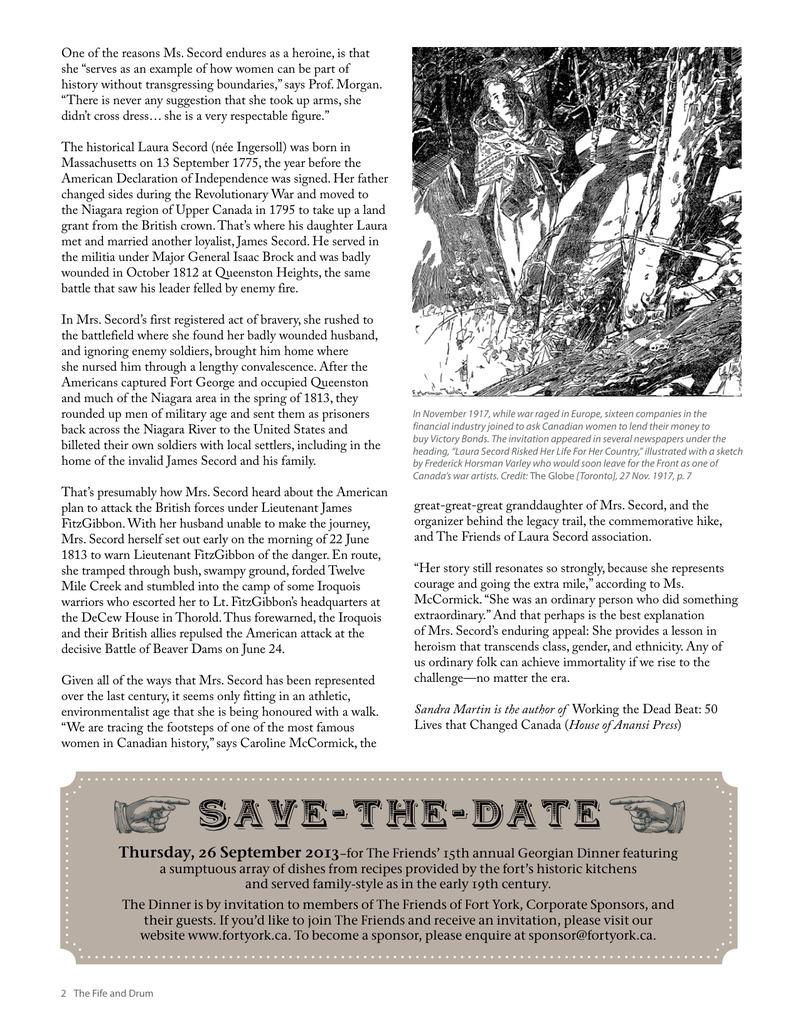
Consequently, Mrs. Secord’s character and appearance have been adapted in plays, poems, and text books to nurture the cultural and social values of any number of groups and causes: symbolizing Imperial ties with Britain; idealizing pioneer resourcefulness; exemplifying women’s duties and responsibilities to family and country; personifying the goals of the suffrage movement; invoking patriotic zeal in the First World War. No less a talent than Fred Varley, later an official war artist and member of the Group of Seven, depicted Mrs. Secord as young and apprehensive but nonetheless intrepid, in a 1917 newspaper campaign to induce women to buy Victory Bonds.
And then, of course, there is the candy company. Founded in 1913, Laura Secord Candy Shops used her as a symbol of domesticity and femininity. When the company reinvented itself with a slick marketing campaign after the Second World War, the dour pioneer image of Ms. Secord also underwent a makeover, losing fifty years and as many pounds to become a younger, more attractive, more upscale version of herself.
One of the reasons Ms. Secord endures as a heroine, is that she “serves as an example of how women can be part of history without transgressing boundaries,” says Prof. Morgan. “There is never any suggestion that she took up arms, she didn’t cross dress… she is a very respectable figure.”
The historical Laura Secord (née Ingersoll) was born in Massachusetts on 13 September 1775, the year before the American Declaration of Independence was signed. Her father changed sides during the Revolutionary War and moved to the Niagara region of Upper Canada in 1795 to take up a land grant from the British crown. That’s where his daughter Laura met and married another loyalist, James Secord. He served in the militia under Major General Isaac Brock and was badly wounded in October 1812 at Queenston Heights, the same battle that saw his leader felled by enemy fire.

In Mrs. Secord’s first registered act of bravery, she rushed to the battlefield where she found her badly wounded husband, and ignoring enemy soldiers, brought him home where she nursed him through a lengthy convalescence. After the Americans captured Fort George and occupied Queenston and much of the Niagara area in the spring of 1813, they rounded up men of military age and sent them as prisoners back across the Niagara River to the United States and billeted their own soldiers with local settlers, including in the home of the invalid James Secord and his family.
That’s presumably how Mrs. Secord heard about the American plan to attack the British forces under Lieutenant James FitzGibbon. With her husband unable to make the journey, Mrs. Secord herself set out early on the morning of 22 June 1813 to warn Lieutenant FitzGibbon of the danger. En route, she tramped through bush, swampy ground, forded Twelve Mile Creek and stumbled into the camp of some Iroquois warriors who escorted her to Lt. FitzGibbon’s headquarters at the DeCew House in Thorold. Thus forewarned, the Iroquois and their British allies repulsed the American attack at the decisive Battle of Beaver Dams on June 24.
Given all of the ways that Mrs. Secord has been represented over the last century, it seems only fitting in an athletic, environmentalist age that she is being honoured with a walk. “We are tracing the footsteps of one of the most famous women in Canadian history,” says Caroline McCormick, the great-great-great granddaughter of Mrs. Secord, and the organizer behind the legacy trail, the commemorative hike, and The Friends of Laura Secord association.
“Her story still resonates so strongly, because she represents courage and going the extra mile,” according to Ms. McCormick. “She was an ordinary person who did something extraordinary.” And that perhaps is the best explanation of Mrs. Secord’s enduring appeal: She provides a lesson in heroism that transcends class, gender, and ethnicity. Any of us ordinary folk can achieve immortality if we rise to the challenge—no matter the era.
Original printed pages