Though Stephen Harper spent up to $24 million helping us commemorate the War of 1812, little was spent in Quebec. Apart from the Battle of Châteauguay, which ended the only powerful American thrust at Montreal, Lower Canada’s role in the war is forgotten, especially by its chief beneficiaries.
Upper Canada’s war effort depended on convincing thousands of recent immigrants from the United States that a tiny British garrison could defeat the American invaders. Bishop Strachan’s version of that feat has sufficed for Ontario textbooks: “never, surely, was greater activity shown in any country than our militia have exhibited, nor greater valour, cooler resolution and more resolved conduct … they have twice saved the country.” Such claims from the chaplain of the Family Compact fit Mr. Harper’s purposes better than more complex truths.
From Michilimackinac to Queenston Heights, Lower Canadians, Native and French-speaking, helped win the battles that reassured Upper Canadians. They could do so because of the long warlike tradition in New France and because most British governors chose a conciliatory role in converting former French colonists to switch allegiances.
Before General James Wolfe’s death, he persuaded his generals to respect the Catholicism of the King’s new subjects. Governor James Murray complied. The Bishop of Quebec had died in 1760. Without a bishop, new clergy could not be ordained. Catholicism would gradually have died, to the delight of many British and Americans. Instead, Murray found a suitable candidate, paid his way to England, and persuaded English Catholics to smuggle him to France to be consecrated. On his return, Bishop Briand earned a salary from Murray’s funds and became a dependable ally.
So did most seigneurs, after Murray defied English-speaking newcomers and used military courts to sustain New France’s legal system from the British but alien Common Law. With clergy and seigneurs as grateful beneficiaries of his policies, Murray’s successor, Guy Carleton, campaigned for a Quebec Act that sustained Murray’s policies. American revolutionaries raged at this abominable provocation.
Murray and Carleton probably accelerated the American Revolution but when revolutionary forces invaded Quebec in 1775, seigneurs and their sons were prominent in the resistance. The invaders left the hideous souvenirs of any untrained, undisciplined army: rape, murder, and pillage. By 1776 it proved much easier to find French-speaking volunteers to carry the war south of the border. France’s 1789 Revolution helped convert Lower Canada’s allegiance from Louis XVI to George III.
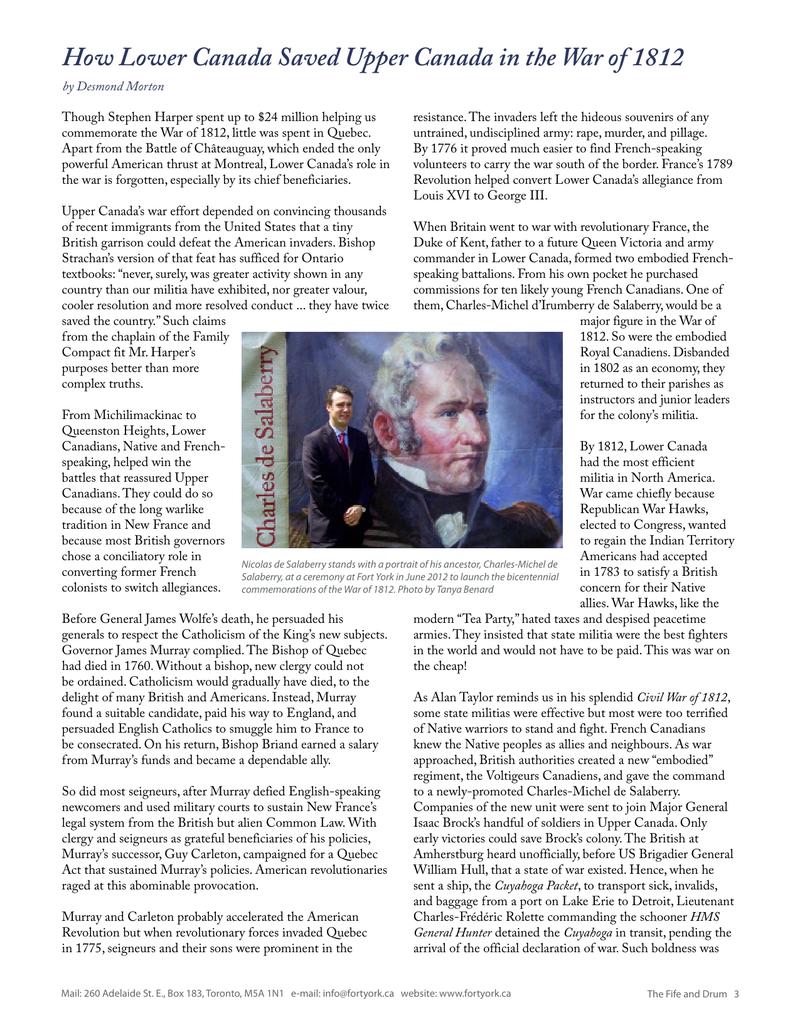
When Britain went to war with revolutionary France, the Duke of Kent, father to a future Queen Victoria and army commander in Lower Canada, formed two embodied French-speaking battalions. From his own pocket he purchased commissions for ten likely young French Canadians. One of them, Charles-Michel d’Irumberry de Salaberry, would be a major figure in the War of 1812. So were the embodied Royal Canadiens. Disbanded in 1802 as an economy, they returned to their parishes as instructors and junior leaders for the colony’s militia.
By 1812, Lower Canada had the most efficient militia in North America. War came chiefly because Republican War Hawks, elected to Congress, wanted to regain the Indian Territory Americans had accepted in 1783 to satisfy a British concern for their Native allies. War Hawks, like the modern “Tea Party,” hated taxes and despised peacetime armies. They insisted that state militia were the best fighters in the world and would not have to be paid. This was war on the cheap!
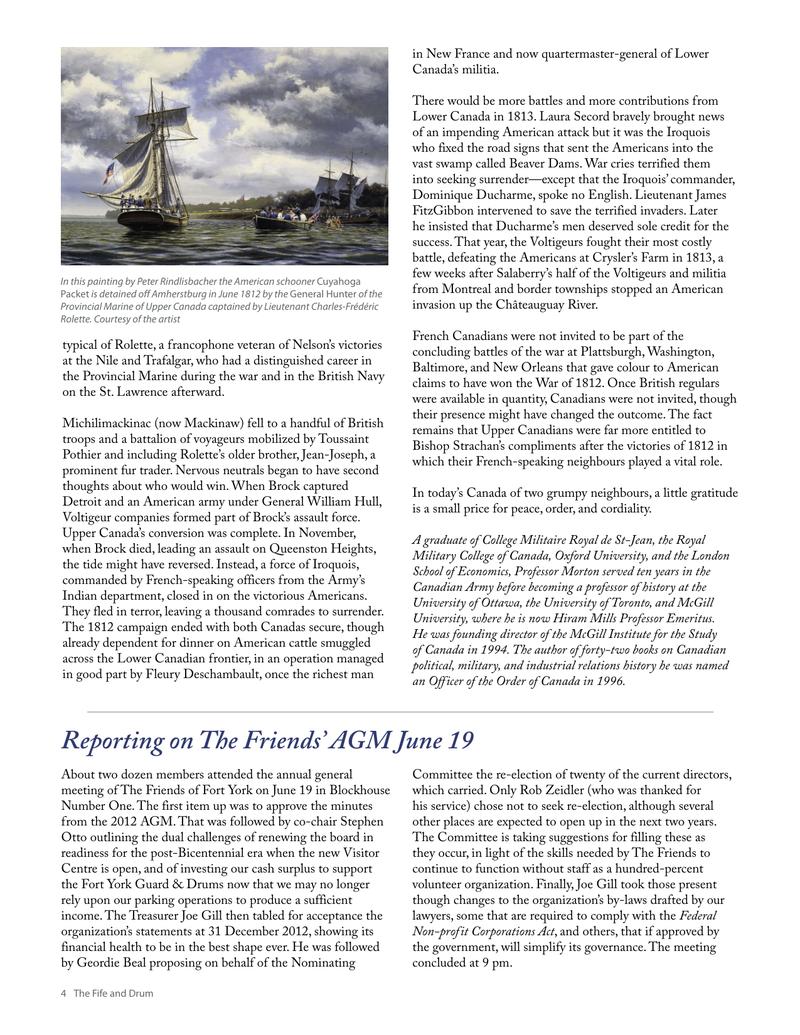
As Alan Taylor reminds us in his splendid Civil War of 1812, some state militias were effective but most were too terrified of Native warriors to stand and fight. French Canadians knew the Native peoples as allies and neighbours. As war approached, British authorities created a new “embodied” regiment, the Voltigeurs Canadiens, and gave the command to a newly-promoted Charles-Michel de Salaberry. Companies of the new unit were sent to join Major General Isaac Brock’s handful of soldiers in Upper Canada. Only early victories could save Brock’s colony. The British at Amherstburg heard unofficially, before US Brigadier General William Hull, that a state of war existed. Hence, when he sent a ship, the Cuyahoga Packet, to transport sick, invalids, and baggage from a port on Lake Erie to Detroit, Lieutenant Charles-Frédéric Rolette commanding the schooner HMS General Hunter detained the Cuyahoga in transit, pending the arrival of the official declaration of war. Such boldness was typical of Rolette, a francophone veteran of Nelson’s victories at the Nile and Trafalgar, who had a distinguished career in the Provincial Marine during the war and in the British Navy on the St. Lawrence afterward.

Michilimackinac (now Mackinaw) fell to a handful of British troops and a battalion of voyageurs mobilized by Toussaint Pothier and including Rolette’s older brother, Jean-Joseph, a prominent fur trader. Nervous neutrals began to have second thoughts about who would win. When Brock captured Detroit and an American army under General William Hull, Voltigeur companies formed part of Brock’s assault force. Upper Canada’s conversion was complete. In November, when Brock died, leading an assault on Queenston Heights, the tide might have reversed. Instead, a force of Iroquois, commanded by French-speaking officers from the Army’s Indian department, closed in on the victorious Americans. They fled in terror, leaving a thousand comrades to surrender. The 1812 campaign ended with both Canadas secure, though already dependent for dinner on American cattle smuggled across the Lower Canadian frontier, in an operation managed in good part by Fleury Deschambault, once the richest man in New France and now quartermaster-general of Lower Canada’s militia.
There would be more battles and more contributions from Lower Canada in 1813. Laura Secord bravely brought news of an impending American attack but it was the Iroquois who fixed the road signs that sent the Americans into the vast swamp called Beaver Dams. War cries terrified them into seeking surrender—except that the Iroquois’ commander, Dominique Ducharme, spoke no English. Lieutenant James FitzGibbon intervened to save the terrified invaders. Later he insisted that Ducharme’s men deserved sole credit for the success. That year, the Voltigeurs fought their most costly battle, defeating the Americans at Crysler’s Farm in 1813, a few weeks after Salaberry’s half of the Voltigeurs and militia from Montreal and border townships stopped an American invasion up the Châteauguay River.
French Canadians were not invited to be part of the concluding battles of the war at Plattsburgh, Washington, Baltimore, and New Orleans that gave colour to American claims to have won the War of 1812. Once British regulars were available in quantity, Canadians were not invited, though their presence might have changed the outcome. The fact remains that Upper Canadians were far more entitled to Bishop Strachan’s compliments after the victories of 1812 in which their French-speaking neighbours played a vital role.
In today’s Canada of two grumpy neighbours, a little gratitude is a small price for peace, order, and cordiality.
Original printed pages