One of the more remarkable housing developments among the great many that have occurred on the Garrison Common was undertaken in the 1850s by James Lukin Robinson, the eldest son of Sir John Beverly Robinson. Like his father, the younger man trained as a lawyer but for a time was active in buying land and putting up buildings to a degree that was far from typical of an offspring of the Family Compact. In 1856, as the economic boom of that decade neared its crest, Robinson had under construction a boarding hotel on Bay Street, an office building on Jordan Street at Melinda as well as several comfortable houses on Windsor Street, which had been laid out like a London square between Front and Wellington. West of the city, he registered a plan of subdivision beyond the Humber River that covered the greater part of the former town of Mimico.
Also in 1856 he began developing nearly eight acres of land in the Garrison Common he bought from Trinity College at auction for £9155 the year before. Bounded by Richmond, Tecumseh, Adelaide and Niagara streets and bisected by Mitchell (formerly Garrison) Street, the property was surveyed into lots by J. O. Browne, P. L. S., shortly before work began on what eventually came to be thirty-two semidetached cottages and eight or nine single ones. All the semidetached cottages were brick-built and substantial; the single ones, with perhaps one exception, were frame and stucco. Building plans for them may have come from either Kivas Tully or Cumberland & Storm, both of whom were working for Robinson on other jobs that year. Boultons’ atlas of 1858 shows the scope of Robinson’s scheme before it was lost among neighbouring houses erected in the 1870s and 1880s. (Fig. 1) Worth noting is the generous amount of land that surrounded each cottage originally.

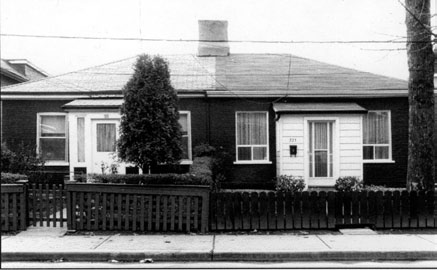

What is remarkable today is that while all Robinson’s single cottages have disappeared (or been incorporated into later buildings), almost half of his semidetached houses – fourteen out of thirty-two – survive in one form or another. The semis number 703-05, 719-721, 735-37 and 753-55 on Richmond Street, and 18-22, 40-44 and 71-75 on Mitchell Street. They are now among the oldest modestly-scaled dwellings in the city. Patrick Cummins, a staff archivist for the City of Toronto as well as a talented photographer, recorded the Robinson cottages in 1983 and 1998. His pictures show how much – or in some cases, how little – they changed in that fifteen-year interval. (Fig. 2)
Original printed pages