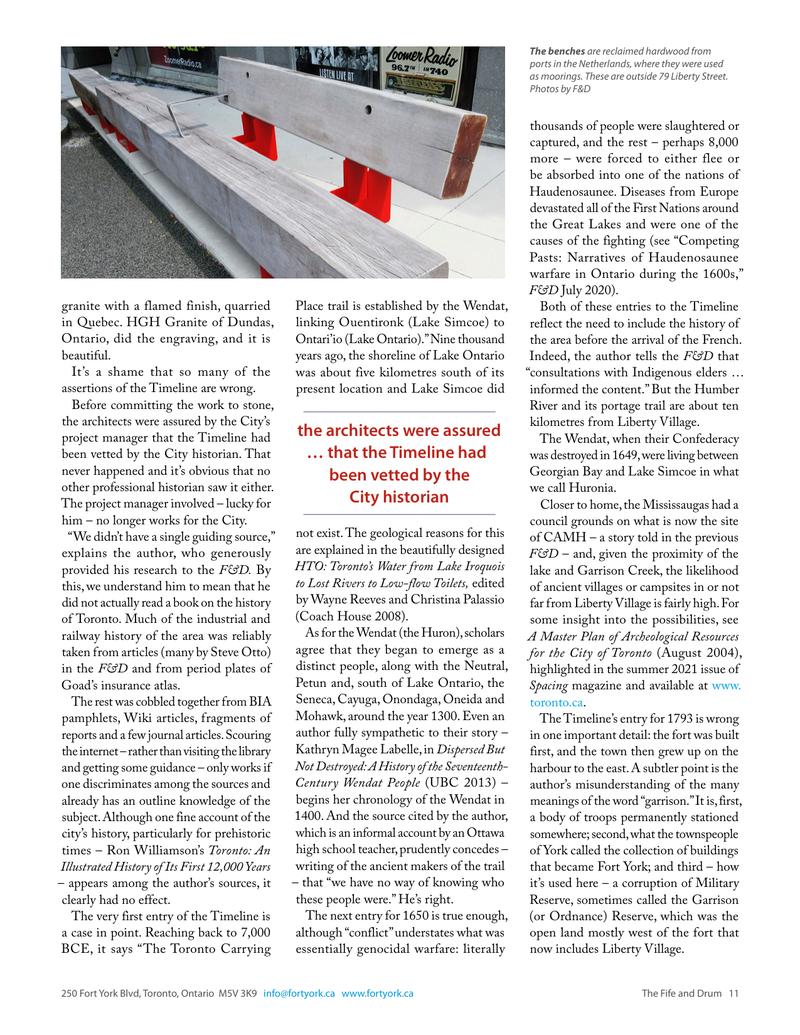
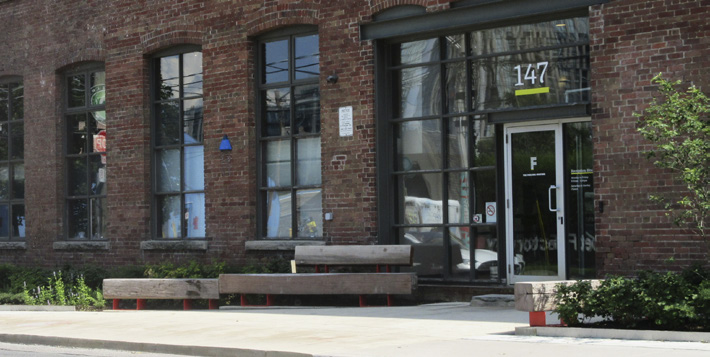
Some lovely new little parks have been installed on Liberty Street by the City and the local Business Improvement Association. Designed by PLANT Architects, they include congenial benches and carefully selected plantings, all in a shady row on the south side of the street. The project was built by CSL Group for a construction cost of about $540,000. Its defining feature is the Timeline (p.13), a set of 19 granite blocks each engraved with two lines about an aspect of the history of Liberty Village. They’re an expensive lesson on how useful it is to actually read a book or two before literally carving nonsense into stone (more on this below).
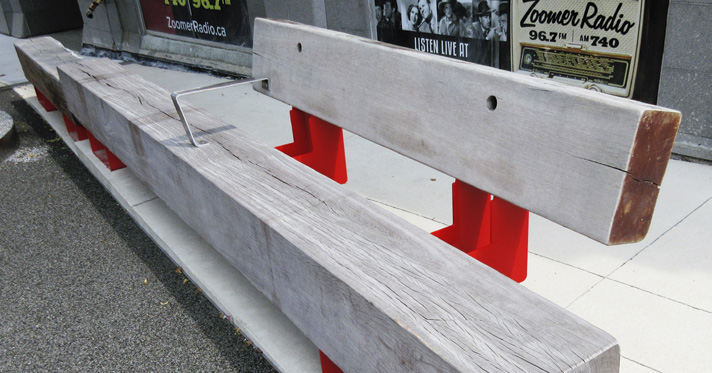
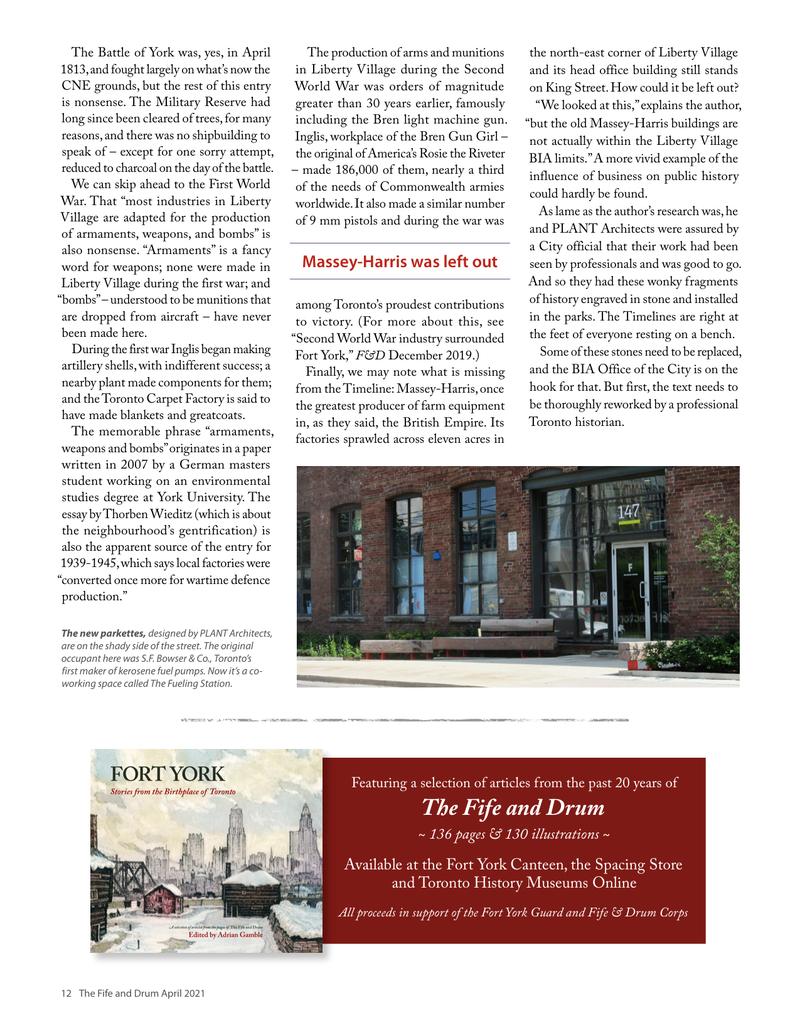
The hefty benches are made of reclaimed European hardwood salvaged from ports in the Netherlands. About 200 years old, they were originally mooring posts. The timber is bolted to the sidewalk through powder-coated steel brackets.
The plantings are a deft mixture of evergreens (for the winter) and perennials that bloom throughout the spring and summer. Matthew Hartney, the designer, explains they were chosen “for their resiliency in an urban environment, pollinator attraction, salt and shade tolerance, and maintenance.” Most species are native to Ontario and will, he hopes, “mature to create dense, verdant gardens.”
The stone used for the Timeline is Picasso granite with a flamed finish, quarried in Quebec. HGH Granite of Dundas, Ontario, did the engraving, and it is beautiful.
It’s a shame that so many of the assertions of the Timeline are wrong. Before committing the work to stone, the architects were assured by the City’s project manager that the Timeline had been vetted by the City historian. That never happened and it’s obvious that no other professional historian saw it either. The project manager involved – lucky for him – no longer works for the City.
the architects were assured … that the Timeline had been vetted by the City historian
“We didn’t have a single guiding source,” explains the author, who generously provided his research to the F&D. By this, we understand him to mean that he did not actually read a book on the history of Toronto. Much of the industrial and railway history of the area was reliably taken from articles (many by Steve Otto) in the F&D and from period plates of Goad’s insurance atlas.
The rest was cobbled together from BIA pamphlets, Wiki articles, fragments of reports and a few journal articles. Scouring the internet – rather than visiting the library and getting some guidance – only works if one discriminates among the sources and already has an outline knowledge of the subject. Although one fine account of the city’s history, particularly for prehistoric times – Ron Williamson’s Toronto: An Illustrated History of Its First 12,000 Years – appears among the author’s sources, it clearly had no effect.
The very first entry of the Timeline is a case in point. Reaching back to 7,000 BCE, it says “The Toronto Carrying Place trail is established by the Wendat, linking Ouentironk (Lake Simcoe) to Ontari’io (Lake Ontario).” Nine thousand years ago, the shoreline of Lake Ontario was about five kilometres south of its present location and Lake Simcoe did not exist. The geological reasons for this are explained in the beautifully designed HTO: Toronto’s Water from Lake Iroquois to Lost Rivers to Low-flow Toilets, edited by Wayne Reeves and Christina Palassio (Coach House 2008).
As for the Wendat (the Huron), scholars agree that they began to emerge as a distinct people, along with the Neutral, Petun and, south of Lake Ontario, the Seneca, Cayuga, Onondaga, Oneida and Mohawk, around the year 1300. Even an author fully sympathetic to their story – Kathryn Magee Labelle, in Dispersed But Not Destroyed: A History of the Seventeenth-Century Wendat People (UBC 2013) – begins her chronology of the Wendat in 1400. And the source cited by the author, which is an informal account by an Ottawa high school teacher, prudently concedes – writing of the ancient makers of the trail – that “we have no way of knowing who these people were.” He’s right.
The next entry for 1650 is true enough, although “conflict” understates what was essentially genocidal warfare: literally thousands of people were slaughtered or captured, and the rest – perhaps 8,000 more – were forced to either flee or be absorbed into one of the nations of Haudenosaunce. Diseases from Europe devastated all of the First Nations around the Great Lakes and were one of the causes of the fighting (see “Competing Pasts: Narratives of Haudenosaunce warfare in Ontario during the 1600s,” F&D July 2020).
Both of these entries to the Timeline reflect the need to include the history of the area before the arrival of the French. Indeed, the author tells the F&D that “consultations with Indigenous elders … informed the content.” But the Humber River and its portage trail are about ten kilometres from Liberty Village.
The Wendat, when their Confederacy was destroyed in 1649, were living between Georgian Bay and Lake Simcoe in what we call Huronia.
Closer to home, the Mississaugas had a council grounds on what is now the site of CAMH – a story told in the previous F&D – and, given the proximity of the lake and Garrison Creek, the likelihood of ancient villages or campsites in or not far from Liberty Village is fairly high. For some insight into the possibilities, see A Master Plan of Archeological Resources for the City of Toronto (August 2004), highlighted in the summer 2021 issue of Spacing magazine and available at www.toronto.ca.
The Timeline’s entry for 1793 is wrong in one important detail: the fort was built first, and the town then grew up on the harbour to the east. A subtler point is the author’s misunderstanding of the many meanings of the word “garrison.” It is, first, a body of troops permanently stationed somewhere; second, what the townspeople of York called the collection of buildings that became Fort York; and third – how it’s used here – a corruption of Military Reserve, sometimes called the Garrison (or Ordnance) Reserve, which was the open land mostly west of the fort that now includes Liberty Village.
The Battle of York was, yes, in April 1813, and fought largely on what is now the CNE grounds, but the rest of this entry is nonsense. The Military Reserve had long since been cleared of trees, for many reasons, and there was no shipbuilding to speak of – except for one sorry attempt, reduced to charcoal on the day of the battle.
We can skip ahead to the First World War. That “most industries in Liberty Village are adapted for the production of armaments, weapons, and bombs” is also nonsense. “Armaments” is a fancy word for weapons; none were made in Liberty Village during the first war; and “bombs” – understood to be munitions that are dropped from aircraft – have never been made here.
During the first war Inglis began making artillery shells, with indifferent success; a nearby plant made components for them; and the Toronto Carpet Factory is said to have made blankets and greatcoats.
Massey-Harris was left out
The memorable phrase “armaments, weapons and bombs” originates in a paper written in 2007 by a German masters student working on an environmental studies degree at York University. The essay by Thorben Wieditz (which is about the neighbourhood’s gentrification) is also the apparent source of the entry for 1939-1945, which says local factories were “converted once more for wartime defence production.”
The production of arms and munitions in Liberty Village during the Second World War was orders of magnitude greater than 30 years earlier. Famously including the Bren light machine gun. Inglis, workplace of the Bren Gun Girl – the original of America’s Rosie the Riveter – made 186,000 of them, nearly a third of the needs of Commonwealth armies worldwide. It also made a similar number of 9 mm pistols and during the war was among Toronto’s proudest contributions to victory. (For more about this, see “Second World War industry surrounded Fort York,” F&D December 2019.)
Finally, we may note what is missing from the Timeline: Massey-Harris, once the greatest producer of farm equipment in, as they said, the British Empire. Its factories sprawled across eleven acres in the north-east corner of Liberty Village and its head office building still stands on King Street. How could it be left out? “We looked at this,” explains the author, “but the old Massey-Harris buildings are not actually within the Liberty Village BIA catchment.” A more vivid example of the influence of business on public history could hardly be found.
As long as the author’s research was, he and PLANT Architects were assured by a City official that their work had been seen by professionals and was good to go. And so they had these wonky fragments of history engraved in stone and installed in the parks. The Timelines are right at the feet of everyone resting on a bench. Some of these stones need to be replaced, and the BIA Office of the City is on the hook for that. But first, the text needs to be thoroughly reworked by a professional Toronto historian.
Sources & Further Reading
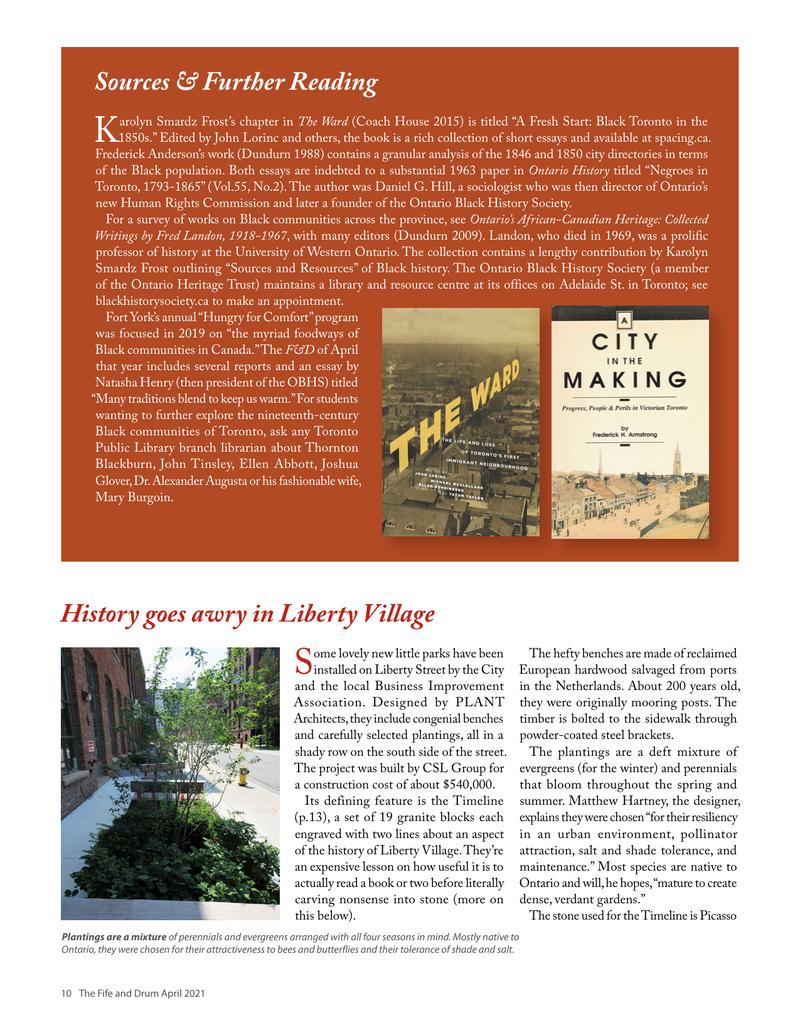
Karolyn Smardz Frost’s chapter in The Ward (Coach House 2015) is titled “A Fresh Start: Black Toronto in the 1850s.” Edited by John Lorinc and others, the book is a rich collection of short essays and available at spacing.ca. Frederick Anderson’s work (Dundurn 1988) contains a granular analysis of the 1846 and 1850 city directories in terms of the Black population. Both essays are indebted to a substantial 1963 paper in Ontario History titled “Negroes in Toronto” (Vol. 57, No. 2). The author was Daniel G. Hill, who was then director of Ontario’s new Human Rights Commission and later a founder of the Ontario Black History Society.
For a survey of works on Black communities across the province, see Ontario’s African-Canadian Heritage: Collected Writings by Fred Landon, 1918-1967, with many editors (Dundurn 2009). Landon, who died in 1969, was a prolific professor of history at the University of Western Ontario. The collection contains a lengthy contribution by Karolyn Smardz Frost, co-author of “Sources and Resources” for the Ontario Black History Society (a member of the Ontario Heritage Trust) maintains a library and resource centre at its offices on Adelaide St. in Toronto; see blackhistorysociety.ca to make an appointment.
Fort York’s annual “Hungry for Comfort” program was focused in 2019 on “the myriad foodways of Black communities in Canada.” The F&D of April that year includes several reports and an essay by Natasha Henry (then president of the OBHS) titled “Many traditions blend to keep us warm.” For students wanting to further explore the nineteenth-century Black communities of Toronto, ask any Toronto Public Library branch librarian about Thornton Blackburn, John Tinsley, Ellen Abbott, Joshua Glover, Dr. Alexander Augusta or his fashionable wife, Mary Burgoin.
Original printed pages