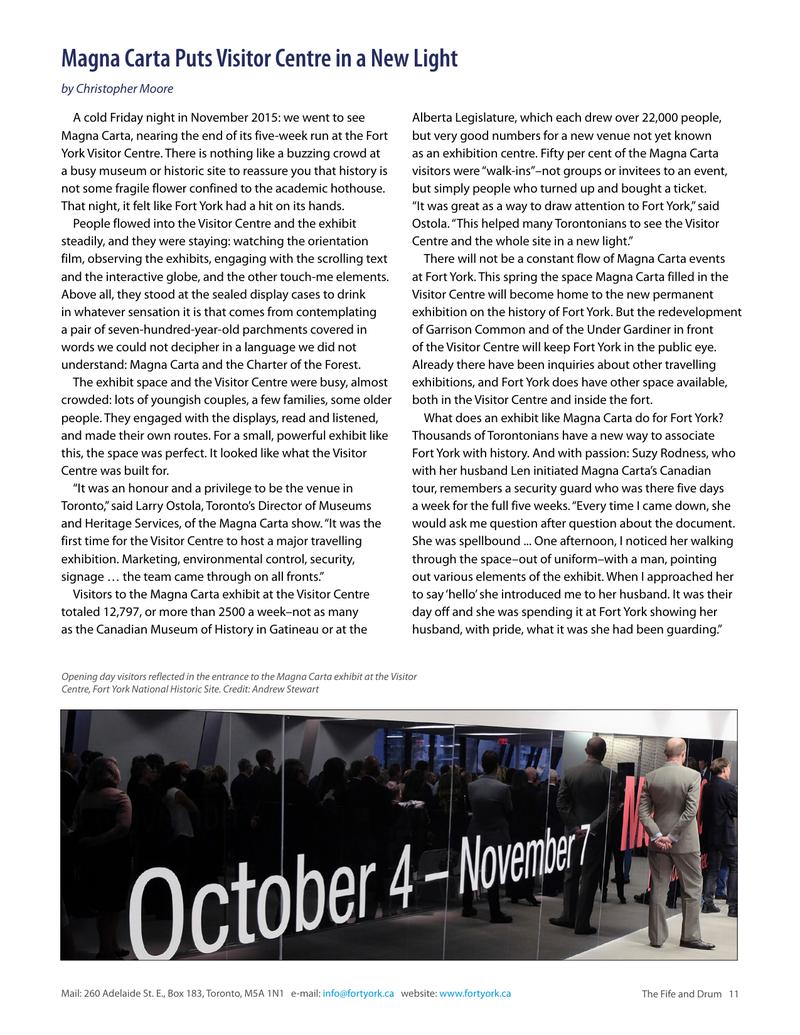
A cold Friday night in November 2015: we went to see Magna Carta, nearing the end of its five-week run at the Fort York Visitor Centre. There is nothing like a buzzing crowd at a busy museum or historic site to reassure you that history is not some fragile flower confined to the academic hothouse. That night, it felt like Fort York had a hit on its hands.
People flowed into the Visitor Centre and the exhibit steadily, and they were staying: watching the orientation film, observing the exhibits, engaging with the scrolling text and the interactive globe, and the other touch-me elements. Above all, they stood at the sealed display cases to drink in whatever sensation it is that comes from contemplating a pair of seven-hundred-year-old parchments covered in words we could not decipher in a language we did not understand: Magna Carta and the Charter of the Forest.
The exhibit space and the Visitor Centre were busy, almost crowded: lots of youngish couples, a few families, some older people. They engaged with the displays, read and listened, and made their own routes. For a small, powerful exhibit like this, the space was perfect. It looked like what the Visitor Centre was built for.
“It was an honour and a privilege to be the venue in Toronto,” said Larry Ostola, Toronto’s Director of Museums and Heritage Services, of the Magna Carta show. “It was the first time for the Visitor Centre to host a major travelling exhibition. Marketing, environmental control, security, signage … the team came through on all fronts.”
Visitors to the Magna Carta exhibit at the Visitor Centre totaled 12,797, or more than 2500 a week–not as many as the Canadian Museum of History in Gatineau or at the Alberta Legislature, which each drew over 22,000 people, but very good numbers for a new venue not yet known as an exhibition centre. Fifty per cent of the Magna Carta visitors were “walk-ins”–not groups or invitees to an event, but simply people who turned up and bought a ticket.
“It was great as a way to draw attention to Fort York,” said Ostola. “This helped many Torontonians to see the Visitor Centre and the whole site in a new light.”
There will not be a constant flow of Magna Carta events at Fort York. This spring the space Magna Carta filled in the Visitor Centre will become home to the new permanent exhibition on the history of Fort York. But the redevelopment of Garrison Common and of the Under Gardiner in front of the Visitor Centre will keep Fort York in the public eye. Already there have been inquiries about other travelling exhibitions, and Fort York does have other space available, both in the Visitor Centre and inside the fort.
What does an exhibit like Magna Carta do for Fort York? Thousands of Torontonians have a new way to associate Fort York with history. And with passion: Suzy Rodness, who with her husband Len initiated Magna Carta’s Canadian tour, remembers a security guard who was there five days a week for the full five weeks. “Every time I came down, she would ask me question after question about the document. She was spellbound … One afternoon, I noticed her walking through the space–out of uniform–with a man, pointing out various elements of the exhibit. When I approached her to say ‘hello’ she introduced me to her husband. It was their day off and she was spending it at Fort York showing her husband, with pride, what it was she had been guarding.”

Original printed pages