

Today, when communications bounce around the world in the bat of an eye, it’s inconceivable that information once took weeks, if not months, to reach its intended destination.
The fort recently acquired two newspapers, thanks to the generosity of an anonymous donor, that provide a direct link to the Battle of York. Both are issues of Boston’s Weekly Messenger, dated May 14 and May 21, 1813. (see Fife & Drum, December 2006)
They provide fascinating accounts of the battle from the American perspective. Found there is news of the American victory, praising the professionalism of US troops and lamenting the death of Brigadier General Zebulon Pike. Included also is Major General Henry Dearborn’s after-action report as the Army Commander, as is that of his naval counterpart, Commodore Isaac Chauncey. In the May 21 issue there is even a list of the British officers who signed the capitulation. These newspapers were paid for and delivered to Toronto faster than the news reached Boston in 1813. So how did the news travel then between the two places?
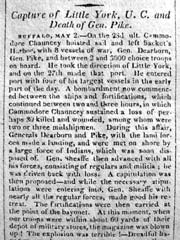
Initially, news of the victory was delayed when a bad storm kept the US Navy’s ships penned up in Toronto harbour. When the storm had blown over, vessels carrying various reports headed out across the lake. Some news reached Buffalo on May 2, and was published in the Buffalo Gazette on May 4. It appeared with its Buffalo dateline in the Weekly Messenger on May 14. Meanwhile, ships carrying naval dispatches also left York for Sackett’s Harbour, the main US Naval base on Lake Ontario. They arrived there on May 3, which explains how some reports first published in other upstate New York towns nearly coincided with the Buffalo dateline but contained different information.
Until the invention of the telegraph in the 1840’s, newspapers were the primary way that news spread over long distances. During the War of 1812 as many as 370 newspapers were being published in the United States–over 90 in New York State alone–and a dozen in Upper Canada. There were no conventions against plagiarism, so articles or portions of them turned up in several journals. The old newspaper maxim of “printing all the news that fits” was never truer than when typesetting was in its infancy. Lines of lead type similar to that of an old typewriter key were placed individually in short rows and then wedged into tight fitting columns before being inked and pressed into broad sheets of newsprint. Once a story was written and the type was set, few changes were made. But a story coming from another newspaper in another part of the country could easily be edited to fit the space available, reset and added to the local edition.
The editor of the Weekly Messenger may have received issues of the Buffalo Gazette or other journals as they published reports on the battle at York, but equally it is likely he copied what he found in other newspapers between Buffalo and Boston. Clearly, it is impossible to say exactly the route that news travelled, when many alternates existed, or precisely where it originated if no dateline and source is given. However, thanks to the generosity of a Friend of Fort York in New York State who shared his transcriptions of thousands of reports on the War of 1812 from US and Canadian newspapers, we’ve been able to locate where many of the reports in the Weekly Messenger first appeared, when they were published, and how long it took them to travel from place to place. A few examples must suffice.
The report titled “Capture of Little York, U.C. and Death of Gen. Pike,” datelined Buffalo, May 2, which was published two days later in the Gazette, appeared in the New York City Statesman on May 10, the Albany Argus on May 11, and the New York Spectator, May 12, before being picked up by the Weekly Messenger on May 14.
Major General Dearborn’s long report to the US Secretary at War, and Commodore Chauncey’s briefer letter to the Secretary of the Navy, both dated at York right after the battle, were direct dispatches later given for publication to Washington DC’s National Intelligencer, from which they were copied by the Weekly Messenger on May 21.
The National Intelligencer was also the source for the signed Terms of Capitulation which have been found so far only in the Weekly Messenger, the Charleston, SC Investigator of May 18 and the Kentucky Gazette, published in Lexington on May 25, 1813.
The two newspapers are a rare find for the fort. Eventually they may be available online for those interested in reading them. A downloaded newspaper is definitely exciting, but it is not the same as holding and seeing the real thing. To know that someone read this paper when it was the latest breaking news is a direct link to the actual event and the most important day in Fort York’s rich history.
Original printed pages


