↗ View this article in the original PDF newsletter
c.7000 BCE The Toronto Carrying Place trail is established by the Wendat, linking Ouentironk (Lake Simcoe) to Ontarí’io (Lake Ontario)
Nine thousand years ago, the edge of Lake Ontario was five kilometres south of the present shoreline and Lake Simcoe did not exist. Who lived here then is impossible to say, but the Wendat (the Huron) as a distinct people only emerged after 1300 CE.
c.1650 The Wendat diaspora begins, a result of conflict with the Haudenosaunee and devastation from European diseases
1750 The French establish Fort Rouillé as a trading post along the Carrying Place trail, south of present-day Dufferin Street
1793 The British military garrison is established west of the Town of York and includes the area now comprising Liberty Village
The blockhouse and barracks were built first; the town subsequently grew up east of the fort, along the shore of the harbour.
c.1810 The Town of York begins its westward expansion into the military garrison with the first issue of private land grants
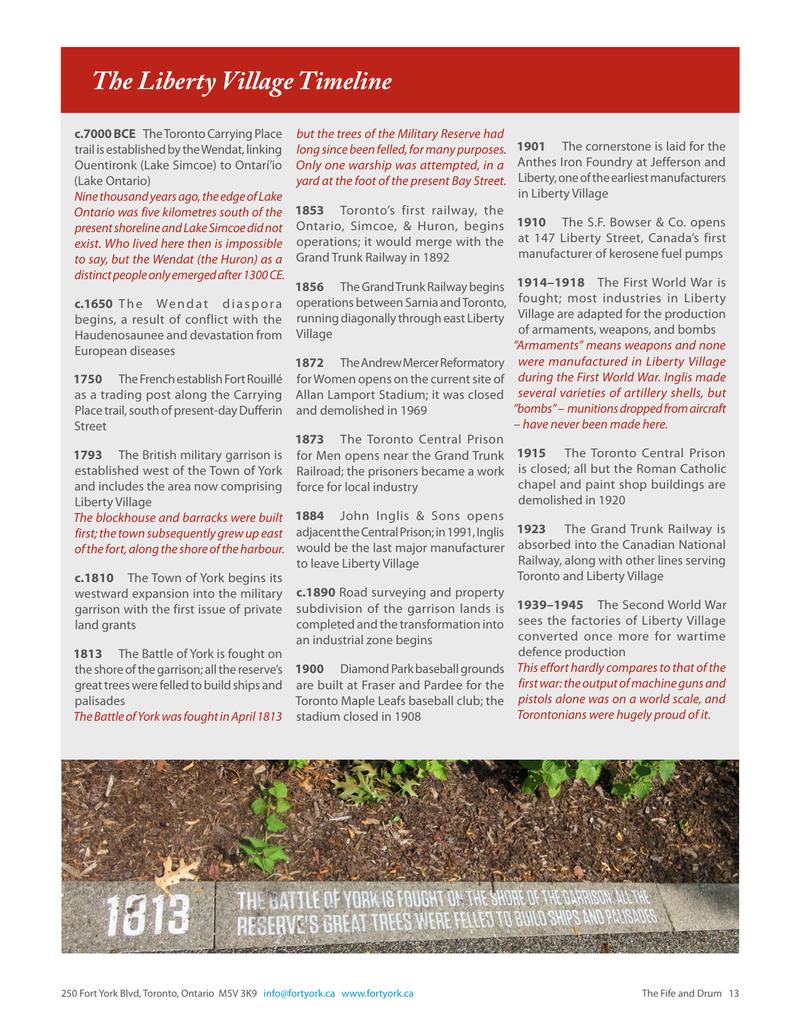
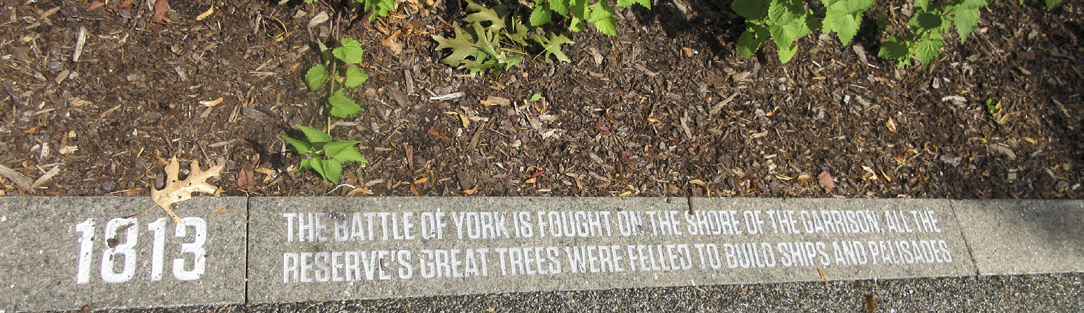
1813 The Battle of York is fought on the shore of the garrison; all the reserve’s great trees were felled to build ships and palisades
The Battle of York was fought in April 1813 but the trees of the Military Reserve had long since been felled, for many purposes. Only one warship was attempted, in a yard at the foot of the present Bay Street.
1853 Toronto’s first railway, the Ontario, Simcoe, & Huron, begins operations; it would merge with the Grand Trunk Railway in 1892
1856 The Grand Trunk Railway begins operations between Sarnia and Toronto, running diagonally through east Liberty Village
1872 The Andrew Mercer Reformatory for Women opens on the current site of Allan Lamport Stadium; it was closed and demolished in 1969
1873 The Toronto Central Prison for Men opens near the Grand Trunk Railroad; the prisoners became a work force for local industry
1884 John Inglis & Sons opens adjacent the Central Prison; in 1991, Inglis would be the last major manufacturer to leave Liberty Village
c.1890 Road surveying and property subdivision of the garrison lands is completed and the transformation into an industrial zone begins
1900 Diamond Park baseball grounds are built at Fraser and Pardee for the Toronto Maple Leafs baseball club; the stadium closed in 1908
1901 The cornerstone is laid for the Anthes Iron Foundry at Jefferson and Liberty, one of the earliest manufacturers in Liberty Village
1910 The S.F. Bowser & Co. opens at 147 Liberty Street, Canada’s first manufacturer of kerosene fuel pumps
1914–1918 The First World War is fought; most industries in Liberty Village are adapted for the production of armaments, weapons, and bombs
“Armaments” means weapons and none were manufactured in Liberty Village during the First World War. Inglis made several varieties of artillery shells, but “bombs” – munitions dropped from aircraft – have never been made here.
1915 The Toronto Central Prison is closed; all but the Roman Catholic chapel and paint shop buildings are demolished in 1920
1923 The Grand Trunk Railway is absorbed into the Canadian National Railway, along with other lines serving Toronto and Liberty Village
1939–1945 The Second World War sees the factories of Liberty Village converted once more for wartime defence production
This effort hardly compares to that of the first war: the output of machine guns and pistols alone was on a world scale, and Torontonians were hugely proud of it.
Original printed pages