↗ View this article in the original PDF newsletter
In the summer of 2021, the Museum of the Royal Canadian Military Institute acquired a very fine collection of early nineteenth-century artifacts. This recent acquisition is an exceptional small collection and named to a Canadian officer of the War of 1812: Captain Michael Carman III of the Dundas County Militia. This single collection was donated to the RCMI by Lynn Leitch on behalf of her father, Nelson Forward; Michael Carman III is Lynn’s four-times-great grandfather. As the Museum Director & Curator of the RCMI, I was introduced to Lynn by Queen’s University scholar Dr. Allan English.
The collection is noteworthy for several reasons. First, authentic War of 1812 artifacts of Canadian origin are seldom encountered. Furthermore, each of the artifacts is in good-to-excellent condition. Given that all War of 1812 objects are now over 200 years old, condition and conservation will continue to be a major concern – especially for organic materials such as leather and wool.
The individuals of the Napoleonic era were unlikely to foresee that their military objects would be saved and preserved for posterity. The fact that Carman’s objects have survived and remain in such fine condition is a testament to the effort and care of his descendants and additional caretakers over many generations. The final layer of noteworthiness on this collection is its named provenance. Indeed, the acquisition of any War of 1812 object would be a coup for a museum, but this collection is named to a specific officer and the objects came directly from his descendants with supporting documents – the best-case scenario for
one of the finest swords in the history of the British Army
museum acquisitions. Rarity, condition, and provenance: a resounding success for Canadian history and heritage.
The material history of the collection
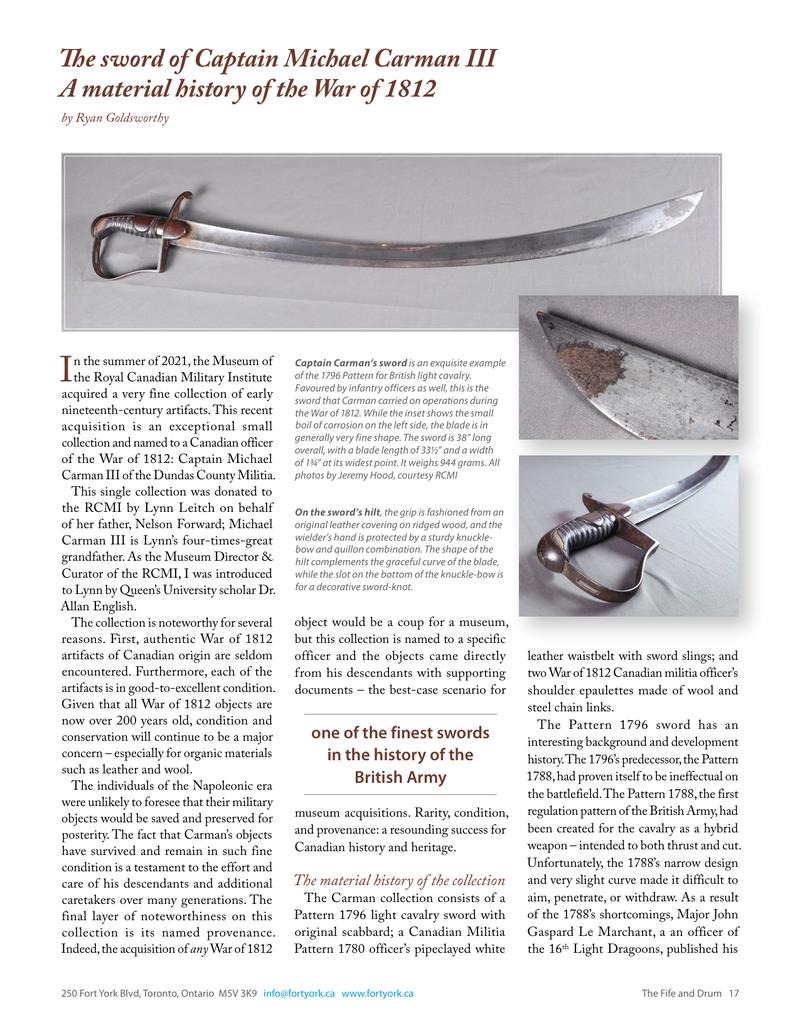
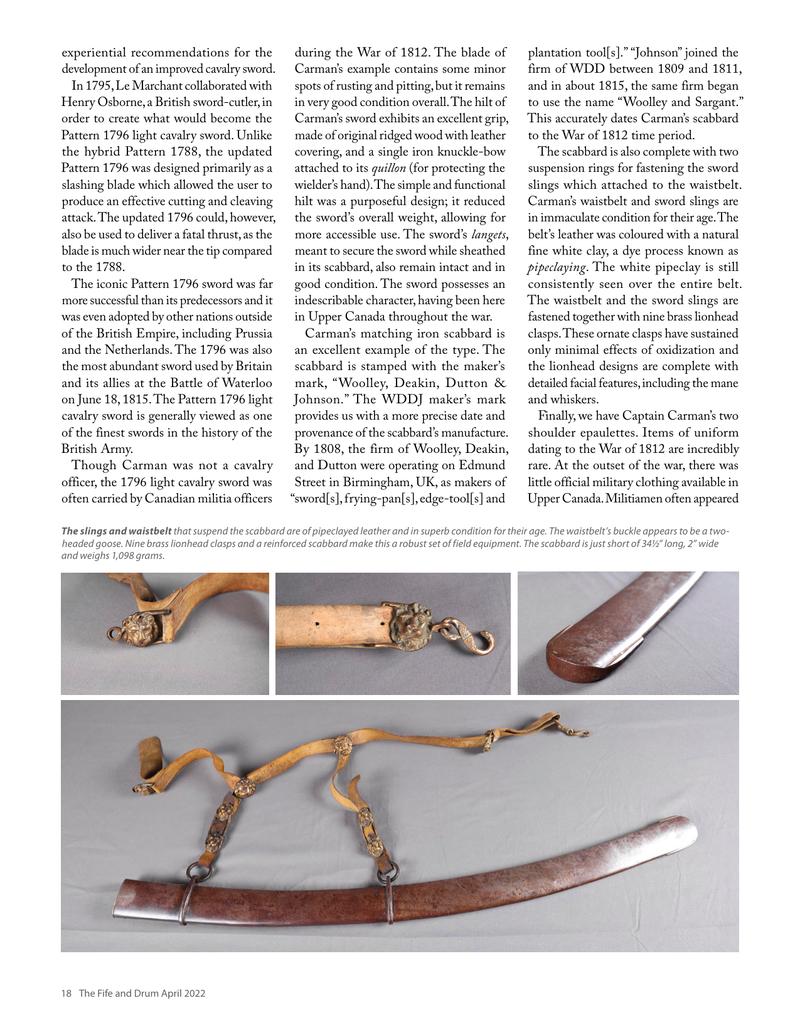
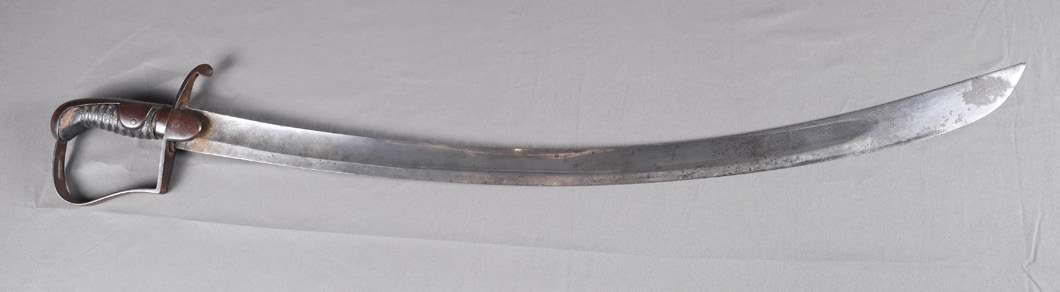
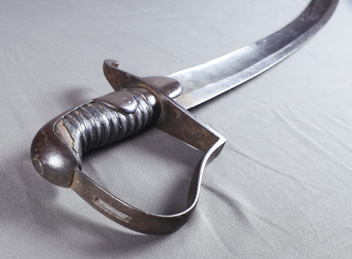
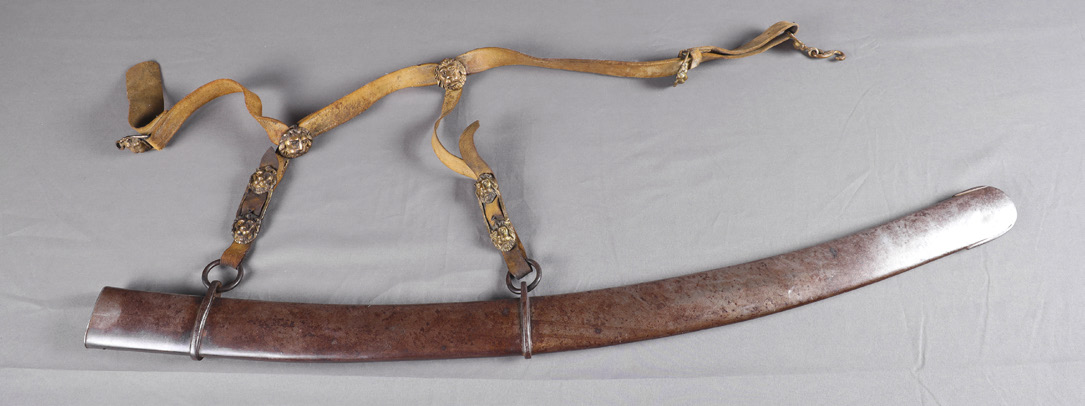
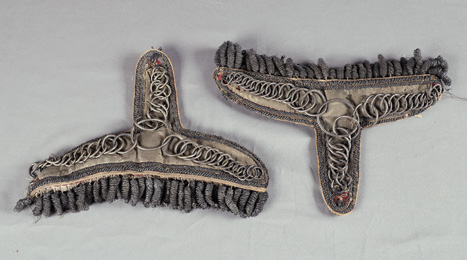
The Carman collection consists of a Pattern 1796 light cavalry sword with original scabbard; a Canadian Militia Pattern 1780 officer’s pipeclayed white leather waistbelt with sword slings; and two War of 1812 Canadian militia officer’s shoulder epaulettes made of wool and steel chain links.
The Pattern 1796 sword has an interesting background and development history. The 1796’s predecessor, the Pattern 1788, had proven itself to be ineffectual on the battlefield. The Pattern 1788, the first regulation pattern of the British Army, had been created for the cavalry as a hybrid weapon – intended to both thrust and cut. Unfortunately, the 1788’s narrow design and very slight curve made it difficult to aim, penetrate, or withdraw. As a result of the 1788’s shortcomings, Major John Gaspard Le Marchant, an officer of the 16th Light Dragoons, published his experiential recommendations for the development of an improved cavalry sword. In 1795, Le Marchant collaborated with Henry Osborne, a British sword-cutler, in order to create what would become the Pattern 1796 light cavalry sword. Unlike the hybrid Pattern 1788, the updated Pattern 1796 was designed primarily as a slashing blade which allowed the user to produce an effective cutting and cleaving attack. The updated 1796 could, however, also be used to deliver a fatal thrust, as the blade is much wider near the tip compared to the 1788.
The iconic Pattern 1796 sword was far more successful than its predecessors and was even adopted by other nations outside of the British Empire, including Prussia and the Netherlands. The 1796 was also the most abundant sword used by Britain and its allies at the Battle of Waterloo on June 18, 1815. The Pattern 1796 light cavalry sword is generally viewed as one of the finest swords in the history of the British Army.
Though Carman was not a cavalry officer, the 1796 light cavalry sword was often carried by Canadian militia officers during the War of 1812. The blade of Carman’s example contains some minor spots of rusting and pitting, but it remains in very good condition overall. The hilt of Carman’s sword exhibits an excellent grip, made of original ridged wood with leather covering, and a single iron knuckle-bow attached to its quillon (for protecting the wielder’s hand). The simple and functional hilt was a purposeful design; it reduced the sword’s overall weight, allowing for more accessible use. The sword’s langét, meant to secure the sword while sheathed in its scabbard, also remain intact and in good condition. The sword possesses an index-striable character, having been here in Upper Canada throughout the war.
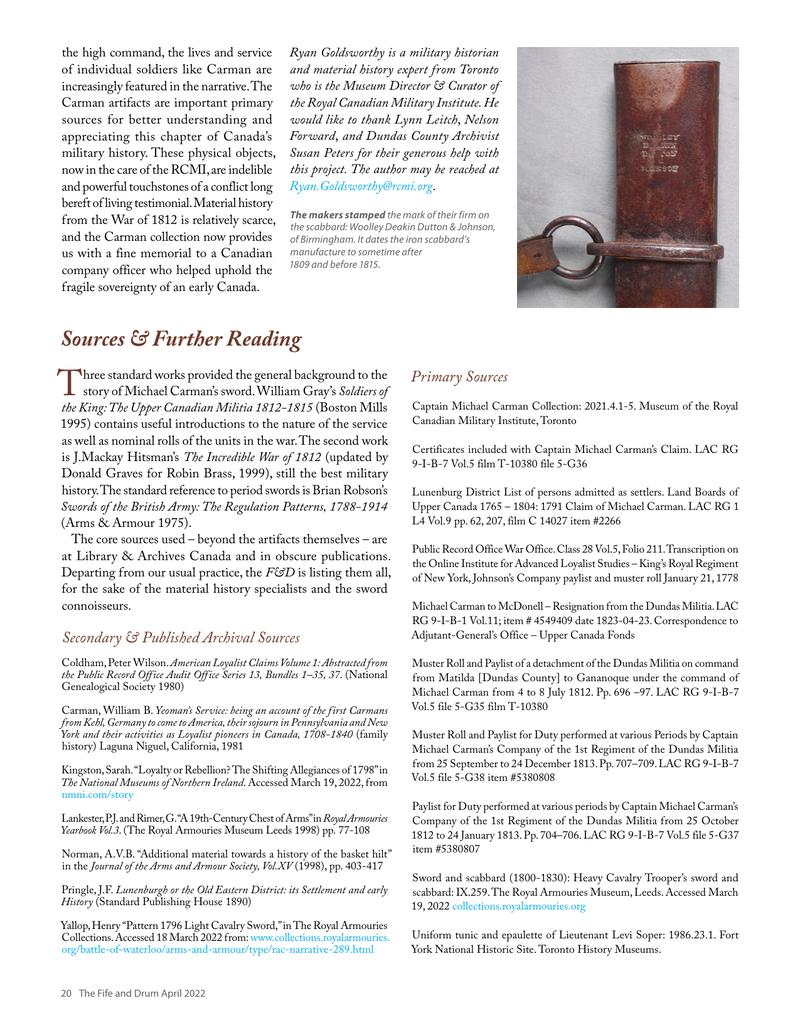
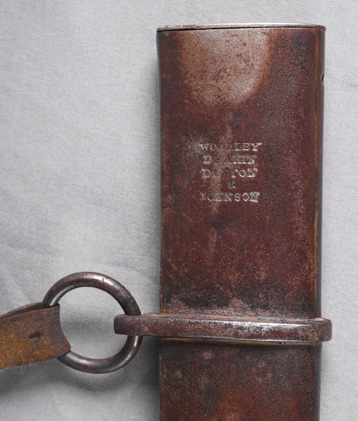
Carman’s matching iron scabbard is an excellent example of the type. The scabbard is stamped with the maker’s mark, “Woolley, Deakin, Dutton & Johnson.” The WDDJ maker’s mark provides us with a more precise date and provenance of the scabbard’s manufacture. By 1808, the firm of Woolley, Deakin, and Dutton were operating on Edmund Street in Birmingham, UK, as makers of “swordf[s], Irving-punk[-edge-tool]s and plantation tool[s].” “Johnson” joined the firm of WDD between 1809 and 1811, and in about 1815, the same firm began to use the name “Woolley and Sarjant.” This accurately dates Carman’s scabbard to the War of 1812 time period.
The scabbard is also complete with two suspension rings for fastening the sword slings which attached to the waistbelt. Carman’s waistbelt and sword slings are in immaculate condition for their age. The belt’s leather was coloured with a natural fine white clay, a dye process known as pipeclaying. The white pipeclay is still consistently seen over the entire belt. The waistbelt and the sword slings are fastened together with nine brass lionhead clasps. These ornate clasps have sustained only minimal effects of oxidization and the lionhead designs are complete with detailed facial features, including the mane and whiskers.
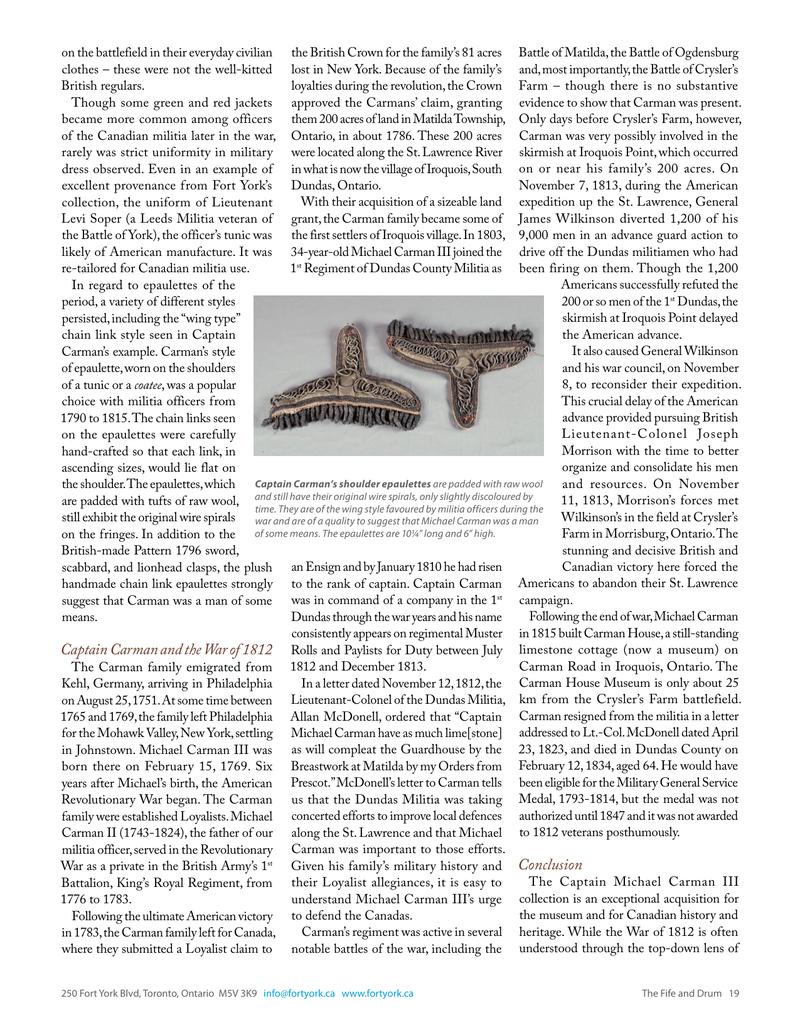
Finally, we have Captain Carman’s two shoulder epaulettes. Items of uniform dating to the War of 1812 are incredibly rare. At the outset of the war, there was little official military clothing available in Upper Canada. Militiamen often appeared on the battlefield in their everyday civilian clothes – there were no Canadian-style red British regulars.
Though some green and red jackets became more common among officers of the Canadian militia later in the war, rarely was strict uniformity in military dress observed. Even in an example of excellent provenance from Fort York’s collection, the uniform of Lieutenant Levi Soper (a Leeds Militia veteran of the Battle of York), the officer’s tunic was likely of American manufacture. It was re-tailored for Canadian militia use.
In regard to epaulettes of the period, a variety of different styles persisted, including the “wing type” chain link style seen in Captain Carman’s example. Carman’s style of epaulette, worn on the shoulders of a tunic or a coatee, was a popular choice with militia officers from 1790 to 1815. The chain links seen on the epaulettes were carefully hand-crafted so that each link, in ascending sizes, would lie flat on the shoulder. The epaulettes, which are padded with tufts of raw wool, still exhibit the original wire pigails on the fringes. In addition to the British-made Pattern 1796 sword, scabbard, and lionhead clasps, the plush handmade chain link epaulettes strongly suggest that Carman was a man of some means.
Captain Carman and the War of 1812
The Carman family emigrated from Kehl, Germany, arriving in Philadelphia on August 25, 1751. At some time between 1765 and 1769, the family left Philadelphia for the Mohawk Valley, New York, settling in Johnstown. Michael Carman III was born there on February 15, 1769. Six years after Michael’s birth, the American Revolutionary War began. The Carman family were established Loyalists. Michael Carman II (1743-1824), the father of our militia officer, served in the Revolutionary War as a private in the British Army’s 1st Battalion, King’s Royal Regiment, from 1776 to 1783.
Following the ultimate American victory in 1783, the Carman family left for Canada, where they submitted a Loyalist claim to the British Crown for the family’s 81 acres lost in New York. Because of the family’s loyalties during the revolution, the Crown approved a partial claim, awarding the family them 200 acres of land in Matilda Township, Ontario, in about 1786. These 200 acres were located along the St. Lawrence River in what is now the village of Iroquois, South Dundas, Ontario.
With their acquisition of a sizeable land grant, the Carmans became some of the first settlers of Iroquois village. In 1803, 34-year-old Michael Carman III joined the 1st Regiment of Dundas County Militia as an Ensign and by January 1810 he had risen to the rank of captain. Captain Carman was in command of a company in the 1st Dundas through the war years and his name consistently appears on regimental Muster Rolls and Paylists for Duty between July 1812 and December 1813.
In a letter dated November 12, 1812, the Lieutenant-Colonel of the Dundas Militia, Allan McDonell, ordered that Captain Michael Carman have as much lime[stone] as will complete the Guardhouse at Breastwork at Matilda by my Orders from Prescot.” McDonell’s letter to Carman tells us that the Dundas Militia was taking concerted efforts to improve local defences along the St. Lawrence and that Michael Carman was important to those efforts. Given his family’s military history and their Loyalist allegiances, it is easy to understand Michael Carman III’s urge to defend the Canadas.
Carman’s regiment was active in several notable battles of the war, including the Battle of Matilda, the Battle of Ogdensburg and, most importantly, the Battle of Crysler’s Farm – though there is no substantive evidence to show that Carman was present. Only days before Crysler’s Farm, however, Carman was very possibly involved in the skirmish at Iroquois Point, which occurred on or near his family’s 200 acres. On November 7, 1813, during the American expedition up the St. Lawrence, General James Wilkinson diverted 1,200 of his 9,000 men in an advance guard action to drive off the Dundas militiamen who had been firing on them. Though the 1,200 Americans successfully refuted the 200 or so men of the 1st Dundas, the skirmish at Iroquois Point delayed the American advance.
It also caused General Wilkinson and his war council, on November 8, to reconsider their expedition. This crucial delay of the American advance provided pursuing British Lieutenant-Colonel Joseph Morrison with the time to better organize and consolidate his men and resources. On November 11, 1813, Morrison’s forces met Wilkinson’s in the field at Crysler’s Farm in Morrisburg, Ontario. The stunning and decisive British and Canadian victory here forced the Americans to abandon their St. Lawrence campaign.
Following the end of war, Michael Carman in 1815 built Carman House, a still-standing limestone cottage (now a museum) on Carman Road in Iroquois, Ontario. The Carman House Museum is only about 25 km from the Crysler’s Farm battlefield. Carman resigned from the militia in a letter addressed to Lt.-Col. McDonell dated April 23, 1825, and died in Dundas County on February 12, 1834, aged 64. He would have been eligible for the Military General Service Medal, 1793-1814, but the medal was not authorized until 1847 and it was not awarded to 1812 veterans posthumously.
Conclusion
The Captain Michael Carman III collection is an exceptional acquisition for the museum and for Canadian history and heritage. While the War of 1812 is often understood through the top-down lens of the high command, the lives and service of individual soldiers themselves are increasingly featured in the narrative. The Carman artifacts are important research sources for better understanding and appreciating this chapter of Canada’s military history. These physical objects, now in the care of the RCMI, are indelible and powerful touchstones devoid of embellishment, bereft of living testimonial. Material history from the War of 1812 is relatively scarce and the Carman collection now provides us with a fine memorial to a Canadian company officer who helped uphold the fragile sovereignty of an early Canada.
Original printed pages