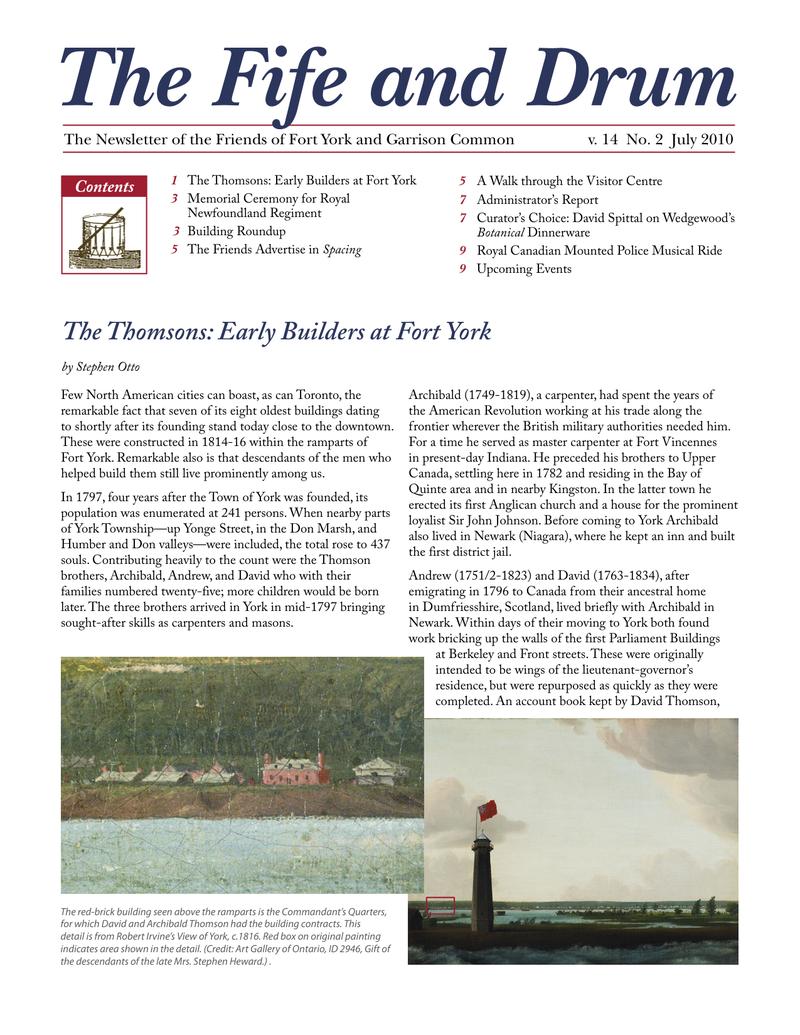
Few North American cities can boast, as can Toronto, the remarkable fact that seven of its eight oldest buildings dating to shortly after its founding stand today close to the downtown. These were constructed in 1814-16 within the ramparts of Fort York. Remarkable also is that descendants of the men who helped build them still live prominently among us.
In 1797, four years after the Town of York was founded, its population was enumerated at 241 persons. When nearby parts of York Township—up Yonge Street, in the Don Marsh, and Humber and Don valleys—were included, the total rose to 437 souls. Contributing heavily to the count were the Thomson brothers, Archibald, Andrew, and David who with their families numbered twenty-five; more children would be born later. The three brothers arrived in York in mid-1797 bringing sought-after skills as carpenters and masons.

Archibald (1749-1819), a carpenter, had spent the years of the American Revolution working at his trade along the frontier wherever the British military authorities needed him. For a time he served as master carpenter at Fort Vincennes in present-day Indiana. He preceded his brothers to Upper Canada, settling here in 1782 and residing in the Bay of Quinte area and in nearby Kingston. In the latter town he erected its first Anglican church and a house for the prominent loyalist Sir John Johnson. Before coming to York Archibald also lived in Newark (Niagara), where he kept an inn and built the first district jail.
Andrew (1751/2-1823) and David (1763-1834), after emigrating in 1796 to Canada from their ancestral home in Dumfriesshire, Scotland, lived briefly with Archibald in Newark. Within days of their moving to York both found work bricking up the walls of the first Parliament Buildings at Berkeley and Front streets. These were originally intended to be wings of the lieutenant-governor’s residence, but were repurposed as quickly as they were completed. An account book kept by David Thomson, now found in the Scarborough Historical Society’s archives, shows that John Thomson (likely Andrew’s son by his first marriage) worked alongside his father and uncle.
Little is known about what jobs Andrew and David undertook after the Parliament Buildings. In 1798 Peter Russell, administrator of the Province in Simcoe’s absence, asked “Mr. Thomson the mason” to help estimate the cost to complete his house, “Russell Abbey.” There was also plenty of work to be had building foundations, hearths, chimneys, and wells. But no other large masonry structures were undertaken in York before 1808 when the stone lighthouse on Gibraltar Point was begun and Quetton St. George, a merchant, built a big brick house at King and Frederick streets.
Carpenters like Archibald, however, were kept busy building the wooden houses and shops that were the common stock in York during the first few decades of its existence. In 1798 Provincial Secretary William Jarvis retained Archibald to secure timber and erect the frame for his house at the southeast corner of Sherbourne and Adelaide streets. Four years later the merchant William Allan hired him to cost and construct a dwelling. William Chewett, a senior official in the surveyor-general’s office, followed suit in 1803.
For whatever reason—a scarcity of work or perhaps a desire to provide better for their families—David and Andrew sought grants of land in Scarborough, where Archibald already owned 700 acres, and began farming. In 1802 David, who was already living there, was also given 400 acres; he and his wife Mary are widely regarded as the township’s first settlers. Andrew received 400 acres too. All the Thomson brothers had big families: Archibald and Elizabeth had eleven children; David and Mary also had eleven; and Andrew who was twice-married had at least twelve.
During the War of 1812 no fewer than a dozen Thomsons served in the Third Regiment of York Militia. David was by far the most eminent of them. He was present at Detroit and Queenston in 1812. When the Americans attacked York in 1813 he ranked as the Captain of a company. His signature and those of Ensigns Andrew and Edward Thomson appeared on the Terms of Capitulation following the Battle of York. Together with their kinsmen they were then released on parole for the duration of hostilities.
The war ended effectively in December 1814 under a treaty negotiated at Ghent in Belgium. This news reached York in February 1815. By then rebuilding the fort was well under way on the present site, west of Garrison Creek. The work was undertaken by a detachment of the Royal Sappers and Miners to plans by Lt. Col. Ralph Bruyères. Members of the local building trades were involved also. They welcomed the work, not only because of the scale of the project but because they were paid in cash.
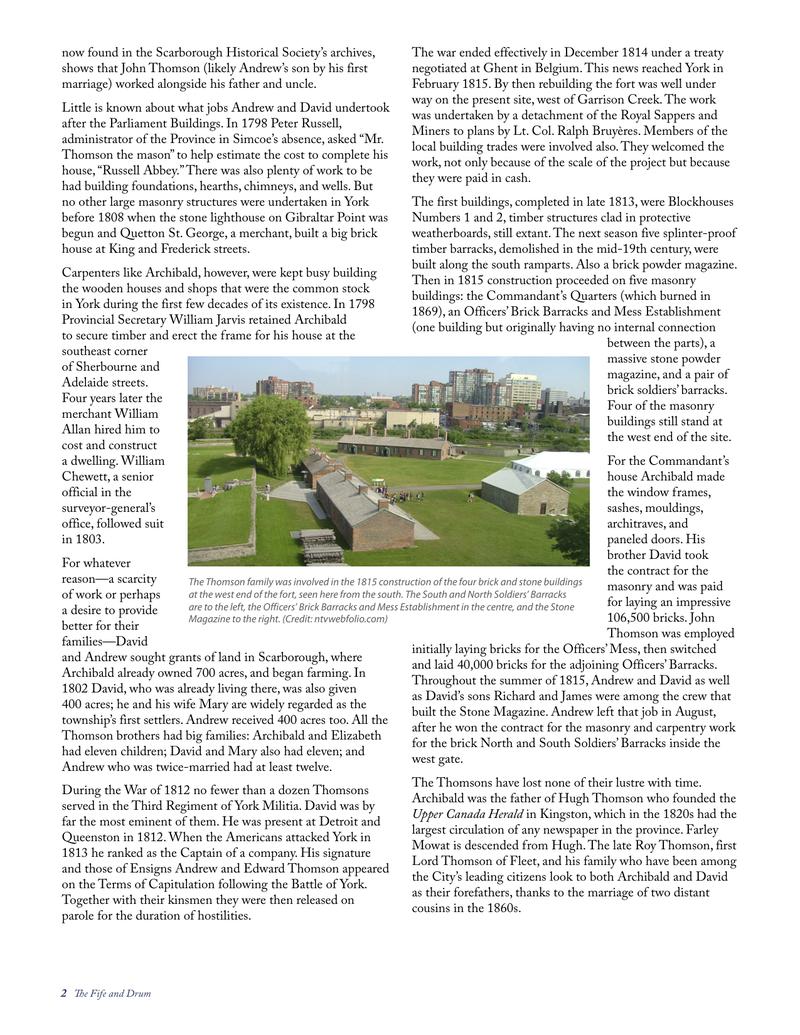
The first buildings, completed in late 1813, were Blockhouses Numbers 1 and 2, timber structures clad in protective weatherboards, still extant. The next season five splinter-proof timber barracks, demolished in the mid-19th century, were built along the south ramparts. Also a brick powder magazine. Then in 1815 construction proceeded on five masonry buildings: the Commandant’s Quarters (which burned in 1869), an Officers’ Brick Barracks and Mess Establishment (one building but originally having no internal connection between the parts), a massive stone powder magazine, and a pair of brick soldiers’ barracks. Four of the masonry buildings still stand at the west end of the site.

For the Commandant’s house Archibald made the window frames, sashes, mouldings, architraves, and paneled doors. His brother David took the contract for the masonry and was paid for laying an impressive 106,500 bricks. John Thomson was employed initially laying bricks for the Officers’ Mess, then switched and laid 40,000 bricks for the adjoining Officers’ Barracks. Throughout the summer of 1815, Andrew and David as well as David’s sons Richard and James were among the crew that built the Stone Magazine. Andrew left that job in August, after he won the contract for the masonry and carpentry work for the brick North and South Soldiers’ Barracks inside the west gate.
The Thomsons have lost none of their lustre with time. Archibald was the father of Hugh Thomson who founded the Upper Canada Herald in Kingston, which in the 1820s had the largest circulation of any newspaper in the province. Farley Mowat is descended from Hugh. The late Roy Thomson, first Lord Thomson of Fleet, and his family who have been among the City’s leading citizens look to both Archibald and David as their forefathers, thanks to the marriage of two distant cousins in the 1860s.
Original printed pages