Between 1802 and 1837 Gustavus Nicolls of the Royal Engineers served twenty-seven years over three tours of duty in British North America working on most of the major forts here. For more than two decades he was Commanding Royal Engineer, twice in both Halifax and Quebec City, which saw him contribute to military preparedness on a national scale across six provinces. However, he is not to be found in the Dictionary of Canadian Biography because of a missed deadline in the 1970s. What follows is an incomplete portrait, needing more research among records such as the Board of Ordnance papers in the UK National Archives.
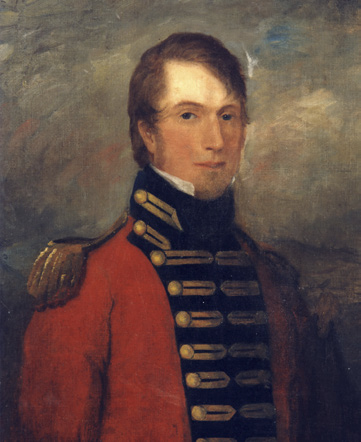
Gustavus Nicolls was born 24 October 1779 in Empacombe on the Rame Peninsula, opposite Plymouth, Devon, the second son of Capt. Gustavus Nicolls of the 1st Regiment of Foot (‘the Royals’) and Elizabeth Dann. About 1785 the senior Nicolls sold his commission, moved his family to Dublin, and purchased the office of Town Major where he functioned like a chief of police. Clearly, the job didn’t require good looks: De Gustibus (his nickname) was said by a contemporary, Oliver Moore, author of The Staff Officer, to be the ugliest man in Dublin.
After Elizabeth Nicolls died in 1788 Gustavus junior was sent to a school taught by the Rev. Anthony Darby in nearby Ballygall, as was his elder brother, Jasper. Five years later Gustavus entered the Royal Military Academy, Woolwich, to train as a Royal Engineer. Gazetted a second lieutenant in 1795 and a first lieutenant two years later, he became a second captain in 1802. He first saw active service in 1796 when he accompanied British regiments sent to reinforce Gibraltar in the war with Spain. He spent 1799–1800 in Martinique and Dominica in the West Indies, but was ill for much of that time with langour and drowsiness from undiagnosed causes that he first experienced during an earlier posting at Gravesend.
After regaining his health in England, Nicolls was ordered on his first tour of duty in Canada late in 1802. It began uneventfully at Fort George, UC, overseeing repairs and the making of barrack furniture. By 1804, however, he had caught the eye of Lieutenant-Governor Peter Hunter and was tasked to design a lighthouse at Niagara; to make repairs and small additions to Fort St. Joseph at the head of Lake Huron (which he welcomed as “an opportunity of seeing a little of the Indians”); and to appraise Chief Justice John Elmsley’s house at York for possible purchase as public offices or a school. That year too he crossed paths with Lt. Col. Isaac Brock with whom he shared a day of quail shooting in the Niagara Gorge; the skilled artist-surgeon Edward Walsh of the 49th Regiment who travelled with him to St. Joseph; and Chief Joseph Brant with whom he took tea en famille.
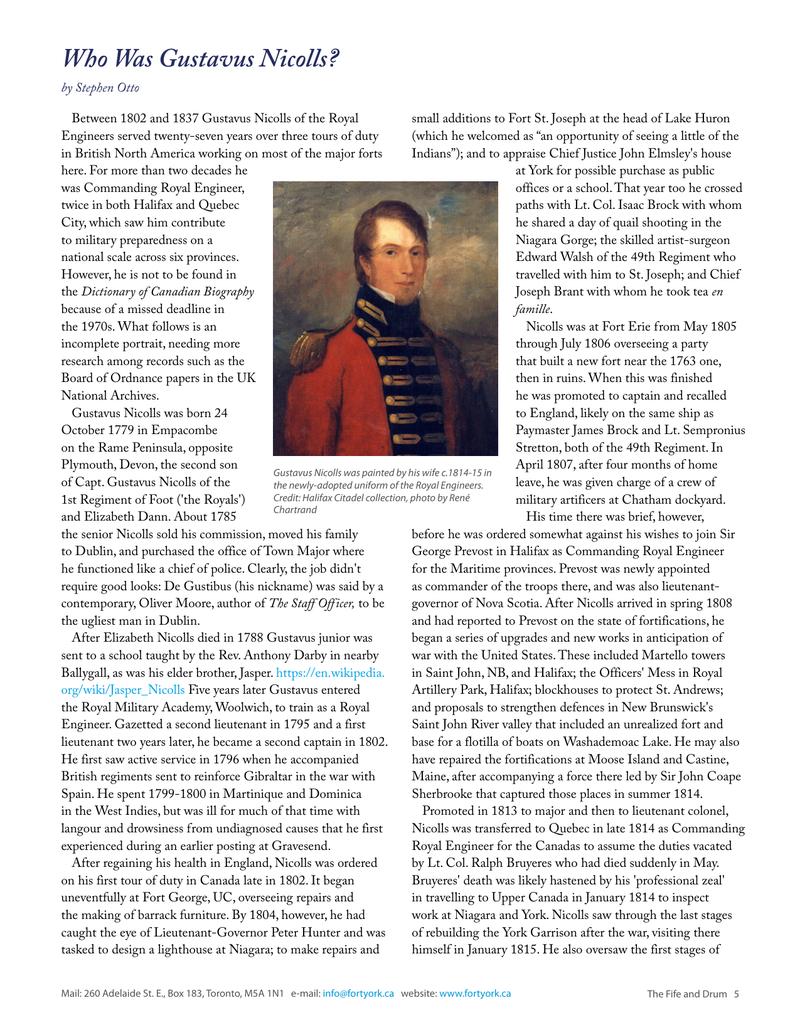
Nicolls was at Fort Erie from May 1805 through July 1806 overseeing a party that built a new fort near the 1763 one, then in ruins. When this was finished he was promoted to captain and recalled to England, likely on the same ship as Paymaster James Brock and Lt. Sempronius Stretton, both of the 49th Regiment. In April 1807, after four months of home leave, he was given charge of a crew of military artificers at Chatham dockyard. His time there was brief, however, before he was ordered somewhat against his wishes to join Sir George Prevost in Halifax as Commanding Royal Engineer for the Maritime provinces. Prevost was newly appointed as commander of the troops there, and was also lieutenant-governor of Nova Scotia. After Nicolls arrived in spring 1808 and had reported to Prevost on the state of fortifications, he began a series of upgrades and new works in anticipation of war with the United States. These included Martello towers in Saint John, NB, and Halifax; the Officers’ Mess in Royal Artillery Park, Halifax; blockhouses to protect St. Andrews; and proposals to strengthen defences in New Brunswick’s Saint John River valley that included an unrealized fort and base for a flotilla of boats on Washademoac Lake. He may also have repaired the fortifications at Moose Island and Castine, Maine, after accompanying a force there led by Sir John Coape Sherbrooke that captured those places in summer 1814.
Promoted in 1813 to major and then to lieutenant colonel, Nicolls was transferred to Quebec in late 1814 as Commanding Royal Engineer for the Canadas to assume the duties vacated by Lt. Col. Ralph Bruyeres who had died suddenly in May. Bruyeres’ death was likely hastened by his ‘professional zeal’ in travelling to Upper Canada in January 1814 to inspect work at Niagara and York. Nicolls saw through the last stages of rebuilding the York Garrison after the war, visiting there himself in January 1815. He also oversaw the first stages of construction of Fort Mississauga at Niagara; the planning of Fort Lennox at Isle-aux-Noix on the Richelieu River; and sundry smaller works at Quebec and Kingston.
What occupied him between leaving North America in 1816 and his return in 1825 is not known except that he and his wife, Heriot Frances Thomson, had four more sons, three in England and one in Guernsey. Their first son had been born in Halifax where they were married in 1812. But no service record or private papers for this time seem to have survived and his obituaries are sketchy.

When Nicolls was reposted to Halifax as Commanding Royal Engineer in 1825, he was soon drawn into helping frame a wide-ranging report by a commission chaired by Sir James Carmichael Smyth, his contemporary at the Royal Military Academy. Among its recommendations was that Fort George on Halifax’s Citadel Hill be rebuilt. Nicolls’ contributions and habitual deference are well described by Joseph Greenough in a 1977 publication from Parks Canada. The Citadel occupied most of his time until he left Halifax, but he also oversaw completion of the ‘Sherbrooke’ Martello tower and lighthouse on McNab’s Island in Halifax harbour. Other designs he made at this time were not realized, for example, barracks and ordnance buildings at the lower cove in Saint John, NB, and additional fortifications on Partridge Island there.

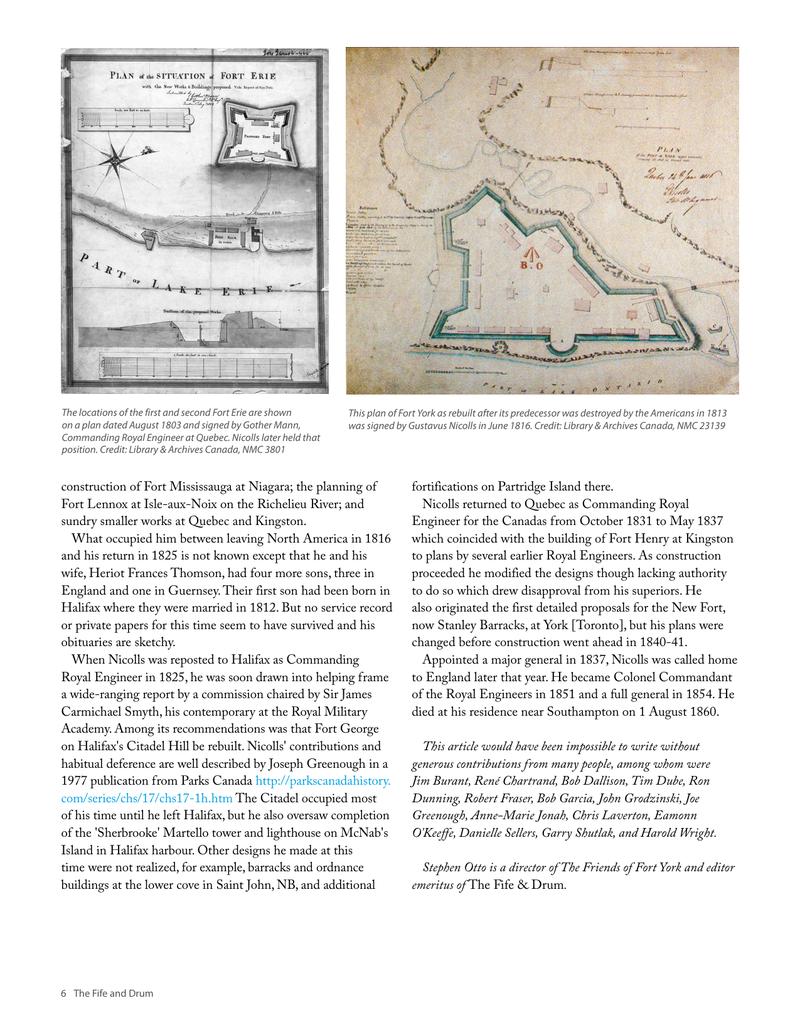
Nicolls returned to Quebec as Commanding Royal Engineer for the Canadas from October 1831 to May 1837 which coincided with the building of Fort Henry at Kingston to plans by several earlier Royal Engineers. As construction proceeded he modified the designs though lacking authority to do so which drew disapproval from his superiors. He also originated the first detailed proposals for the New Fort, now Stanley Barracks, at York [Toronto], but his plans were changed before construction went ahead in 1840–41.
Appointed a major general in 1837, Nicolls was called home to England later that year. He became Colonel Commandant of the Royal Engineers in 1851 and a full general in 1854. He died at his residence near Southampton on 1 August 1860.
This article would have been impossible to write without generous contributions from many people, among whom were Jim Burant, René Chartrand, Bob Dallison, Tim Dube, Ron Dunning, Robert Fraser, Bob Garcia, John Grodzinski, Joe Greenough, Anne-Marie Jonah, Chris Laverton, Eamonn O’Keeffe, Danielle Sellers, Garry Shutlak, and Harold Wright.
Original printed pages