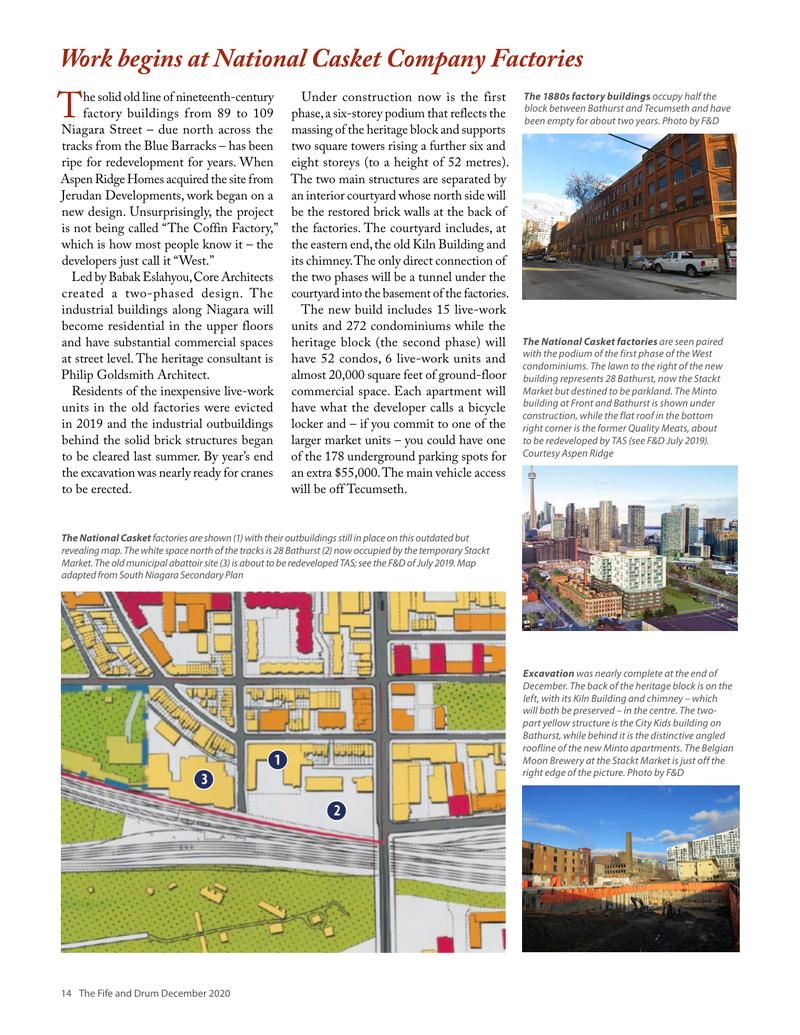
The solid old line of nineteenth-century factory buildings from 89 to 109 Niagara Street – due north across the tracks from the Blue Barracks – has been ripe for redevelopment for years. When Aspen Ridge Homes acquired the site from Jerudan Developments, work began on a new design. Unsurprisingly, the project is not being called “The Coffin Factory,” which is how most people know it – the developers just call it “West.”
Led by Babak Eslahyou, Core Architects created a two-phased design. The industrial buildings along Niagara will become residential in the upper floors and have substantial commercial spaces at street level. The heritage consultant is Philip Goldsmith Architect.
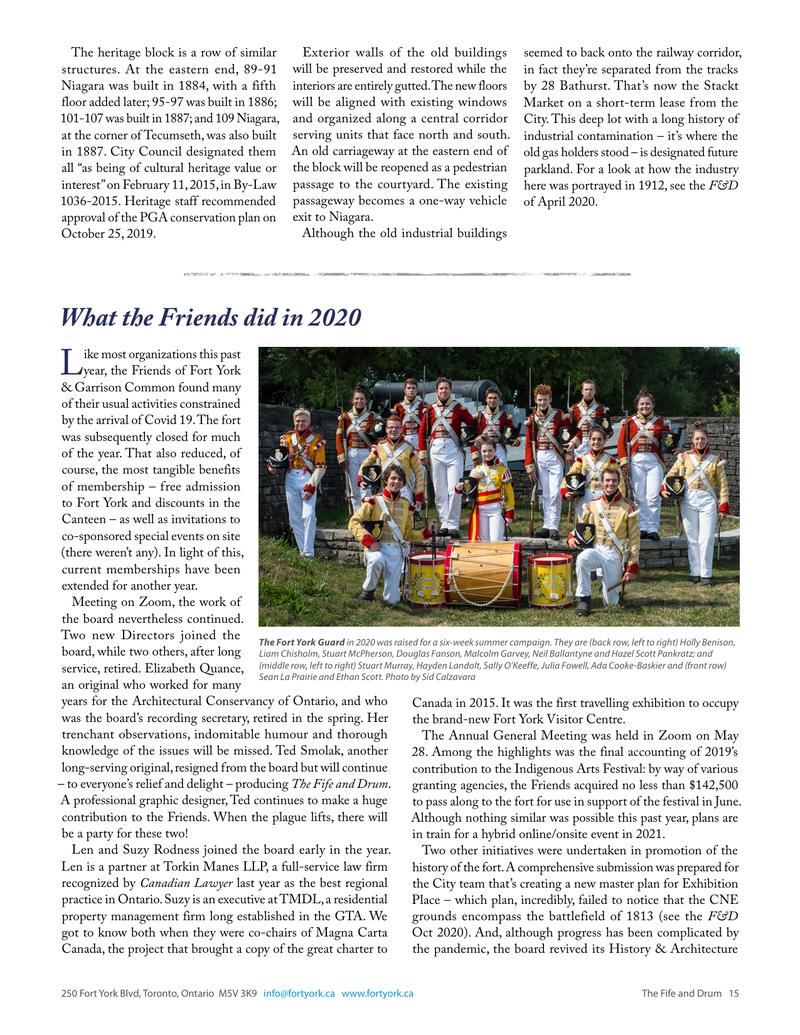
Residents of the inexpensive live-work units in the old factories were evicted in 2019 and the industrial outbuildings behind the solid brick structures began to be cleared last summer. By year’s end the excavation was nearly ready for cranes to be erected.
Under construction now is the first phase, a six-storey podium that reflects the massing of the heritage block and supports two square towers rising a further six and eight storeys (to a height of 52 metres). The two main structures are separated by an interior courtyard whose north side will be the restored brick walls at the back of the factories. The courtyard includes, at the eastern end, the old Kiln Building and its chimney. The only direct connection of the two phases will be a tunnel under the courtyard into the basement of the factories.
The new build includes 15 live-work units and 272 condominiums while the heritage block (the second phase) will have 52 condos, 6 live-work units and almost 20,000 square feet of ground-floor commercial space. Each apartment will have what the developer calls a bicycle locker and – if you commit to one of the larger market units – you could have one of the 178 underground parking spots for an extra $55,000. The main vehicle access will be off Tecumseth.
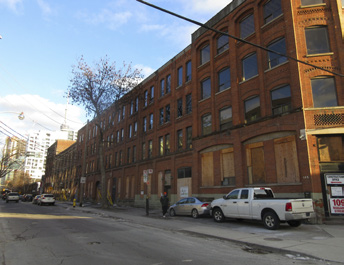

The heritage block is a row of similar structures. At the eastern end, 89-91 Niagara was built in 1884, with a fifth floor added later; 95-97 was built in 1886; 101-107 was built in 1887; and 109 Niagara, at the corner of Tecumseth, was also built in 1887. City Council designated them all “as being of cultural heritage value or interest” on February 11, 2015, in By-Law 1036-2015. Heritage staff recommended approval of the PGA conservation plan on October 25, 2019.
Exterior walls of the old buildings will be preserved and restored while the interiors are entirely gutted. The new floors will be aligned with existing windows and organized along a central corridor serving units that face north and south. An old carriageway at the eastern end of the block will be reopened as a pedestrian passage to the courtyard. The existing passageway becomes a one-way vehicle exit to Niagara.
Although the old industrial buildings seemed to back onto the railway corridor, in fact they’re separated from the tracks by 28 Bathurst. That’s now the Stackt Market on a short-term lease from the City. This deep lot with a long history of industrial contamination – it’s where the old gas holders stood – is designated future parkland. For a look at how the industry here was portrayed in 1912, see the F&D of April 2020.
Original printed pages