In the spring of 1813, as American forces readied to strike York, Upper Canada, a fifteen-year-old runaway enlisted with the US Army in New York. After spending time on Governor’s Island in the city’s harbour, the recruit would go on to serve in the attempted invasion of Montreal that October and again the following March. Months later, he headed to Plattsburgh, New York, poised to defend it against what was ultimately a scuttled British campaign. The young man’s name was William Apess (or Apes), a descendant of the Pequot nation in southern New England.
Apess was just one of many Indigenous peoples who fought alongside or against American and British soldiers in a multinational geopolitical struggle that waged across the continent. But the indentured servant turned soldier, vagabond turned Methodist missionary was somewhat unique in that he recorded his wartime experiences in print, most notably in his self-published autobiography, A Son of the Forest (1829). Apess offers a first-hand account of life as a nineteenth-century soldier—a rarity in its own right and thus invaluable regardless of his ancestry—and an at-times pointed critique of racism within the ranks, as well as of US government policy toward American Indians.
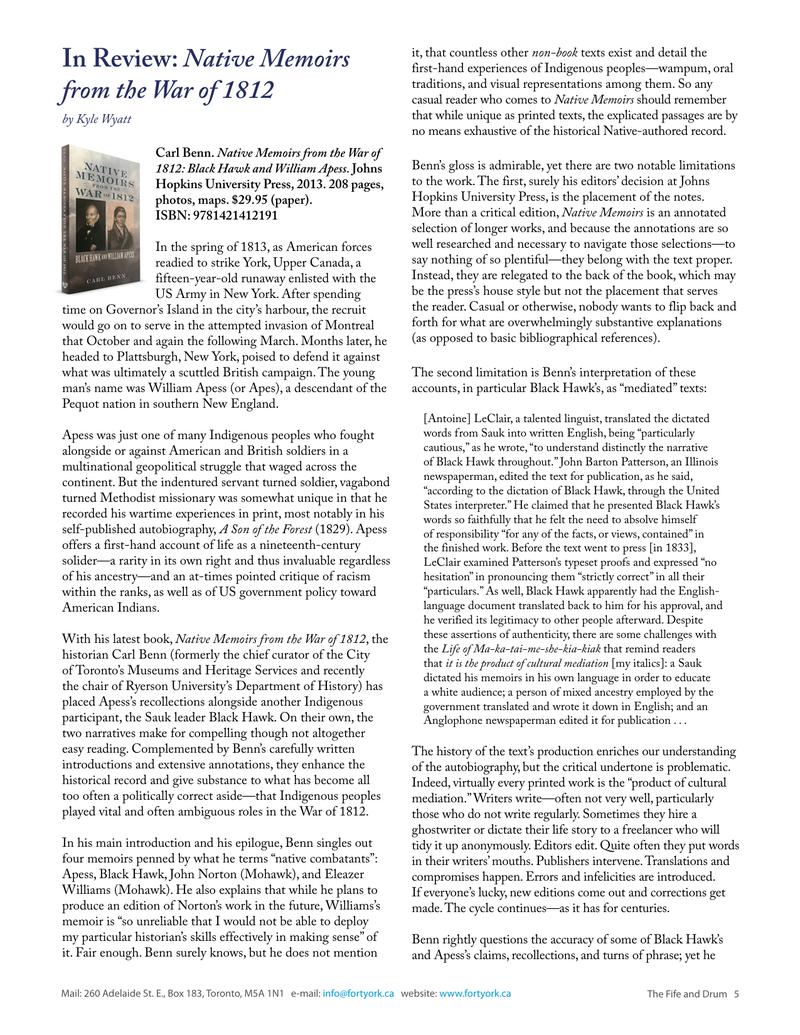
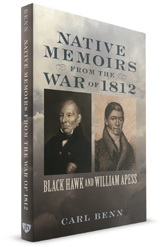
With his latest book, Native Memoirs from the War of 1812, the historian Carl Benn (formerly the chief curator of the City of Toronto’s Museums and Heritage Services and recently the chair of Ryerson University’s Department of History) has placed Apess’s recollections alongside another Indigenous participant, the Sauk leader Black Hawk. On their own, the two narratives make for compelling though not altogether easy reading. Complemented by Benn’s carefully written introductions and extensive annotations, they enhance the historical record and give substance to what has become all too often a politically correct aside—that Indigenous peoples played vital and often ambiguous roles in the War of 1812.
In his main introduction and his epilogue, Benn singles out four memoirs penned by what he terms “native combatants”: Apess, Black Hawk, John Norton (Mohawk), and Eleazer Williams (Mohawk). He also explains that while he plans to produce an edition of Norton’s work in the future, Williams’s memoir is “so unreliable that I would not be able to deploy my particular historian’s skills effectively in making sense” of it. Fair enough. Benn surely knows, but he does not mention it, that countless other non-book texts exist and detail the first-hand experiences of Indigenous peoples—wampum, oral traditions, and visual representations among them. So any casual reader who comes to Native Memoirs should remember that while unique as printed texts, the explicated passages are by no means exhaustive of the historical Native-authored record.
Benn’s gloss is admirable, yet there are two notable limitations to the work. The first, surely his editors’ decision at Johns Hopkins University Press, is the placement of the notes. More than a critical edition, Native Memoirs is an annotated selection of longer works, and because the annotations are so well researched and necessary to navigate those selections—to say nothing of so plentiful—they belong with the text proper. Instead, they are relegated to the back of the book, which may be the press’s house style but not the placement that serves the reader. Casual or otherwise, nobody wants to flip back and forth for what are overwhelmingly substantive explanations (as opposed to basic bibliographical references).
The second limitation is Benn’s interpretation of these accounts, in particular Black Hawk’s, as “mediated” texts:
[Antoine] LeClair, a talented linguist, translated the dictated words from Sauk into written English, being “particularly cautious,” as he wrote, “to understand distinctly the narrative of Black Hawk throughout.” John Barton Patterson, an Illinois newspaperman, edited the text for publication, as he said, “according to the dictation of Black Hawk, through the United States interpreter.” He claimed that he presented Black Hawk’s words so faithfully that he felt the need to absolve himself of responsibility “for any of the facts, or views, contained” in the finished work. Before the text went to press [in 1833], LeClair examined Patterson’s typeset proofs and expressed “no hesitation” in pronouncing them “strictly correct” in all their “particulars.” As well, Black Hawk apparently had the English-language document translated back to him for his approval, and he verified its legitimacy to other people afterward. Despite these assertions of authenticity, there are some challenges with the Life of Ma-ka-tai-me-she-kia-kiak that remind readers that it is the product of cultural mediation [my italics]: a Sauk dictated his memoirs in his own language in order to educate a white audience; a person of mixed ancestry employed by the government translated and wrote it down in English; and an Anglophone newspaperman edited it for publication . . .
The history of the text’s production enriches our understanding of the autobiography, but the critical undertone is problematic. Indeed, virtually every printed work is the “product of cultural mediation.” Writers write—often not very well, particularly those who do not write regularly. Sometimes they hire a ghostwriter or dictate their life story to a freelancer who will tidy it up anonymously. Editors edit. Quite often they put words in their writers’ mouths. Publishers intervene. Translations and compromises happen. Errors and infelicities are introduced. If everyone’s lucky, new editions come out and corrections get made. The cycle continues—as it has for centuries.
Benn rightly questions the accuracy of some of Black Hawk’s and Apess’s claims, recollections, and turns of phrase; yet he himself has produced a work of cultural mediation based on twenty-first-century conventions. Particularly with Black Hawk’s text, Benn’s edits risk changing the intended meaning, and perhaps the tone and rhetorical strategies at work; even as Benn reaffirms the Sauk leader’s military and political agency, he questions him as an author. Purple prose aside, nineteenth-century literature is littered with exclamation points and italics and other dated usages. With the intention of aiding the modern reader, Benn has removed most of these from his primary texts, has altered paragraph breaks, and has inserted chronological markers where they did not previously exist. However helpful, we would find such interventions presumptuous or at least questionable with the life writing of John Richardson or Ulysses S. Grant or Susanna Moodie.
Overall, though, Benn’s new book encourages the renewed circulation and consideration of two primary texts from the War of 1812. Because both Black Hawk and William Apess fought in Canada, their carefully annotated narratives will still be of interest to those wanting a more fulsome understanding of the frontlines north of the border.
Original printed pages