↗ View this article in the original PDF newsletter
The first year of the War of 1812 did not go well for the young United States. After a steady series of defeats — at the top of Lake Michigan, at Detroit, at Queenston, and in northern New York — by the spring of 1813 the only American soldiers on Canadian soil were prisoners of war. Clearly, conquering Canada would not be “a mere matter of marching,” as Thomas Jefferson remarked in a letter to a friend shortly after the war began.
A new plan was made and its first move was a major raid on the little town of York (later to regain its original name of Toronto). The target was well chosen. The town was more lightly defended than the formidable base at Kingston. There was a warship bigger than anything the Americans had on Lake Ontario that was soon to be launched. And York was the capital of Upper Canada, whose capture would be a major propaganda victory and a huge boost to American morale.

On Sunday, April 25, 1813 — as soon as the ice cleared — a US Navy squadron of 13 warships, commanded by Commodore Isaac Chauncey, sailed from Sackets Harbor, New York, at the eastern end of Lake Ontario. On board were almost 1,800 troops, including artillery, of Brigadier General Zebulon Pike’s brigade. Defending York was a collection of British regulars, York militia and First Nations warriors totalling about 1,000 men under the command of Major General Sir Roger Sheaffe (the successor to Isaac Brock, killed the previous October).

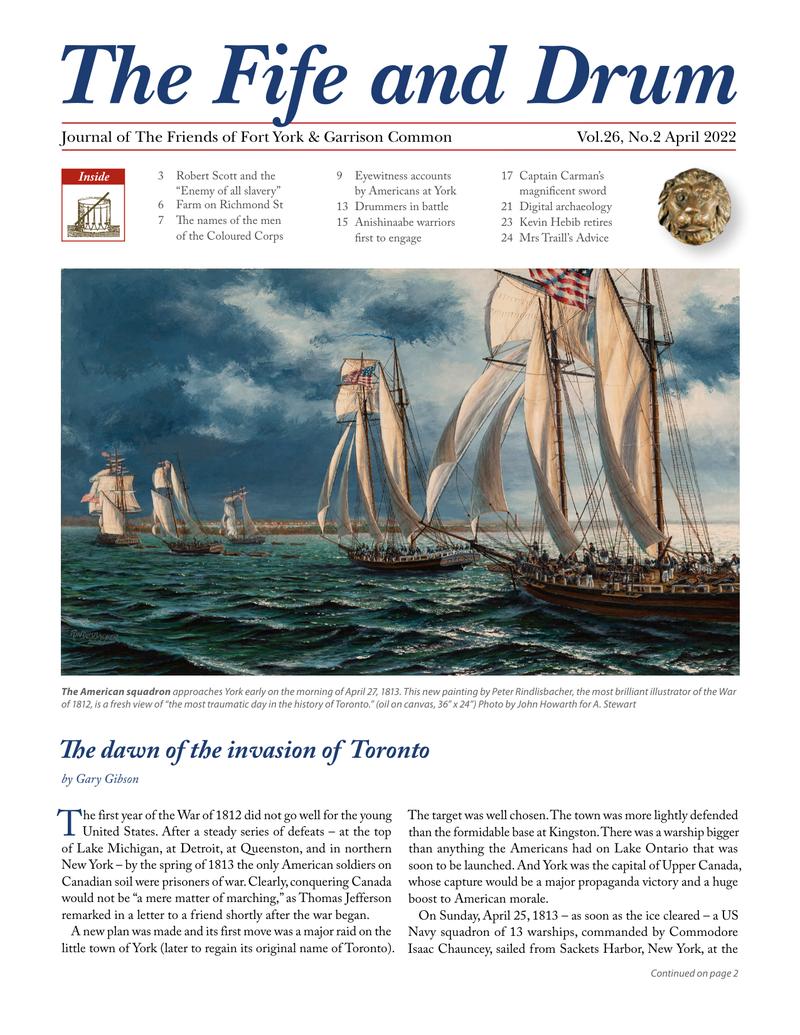
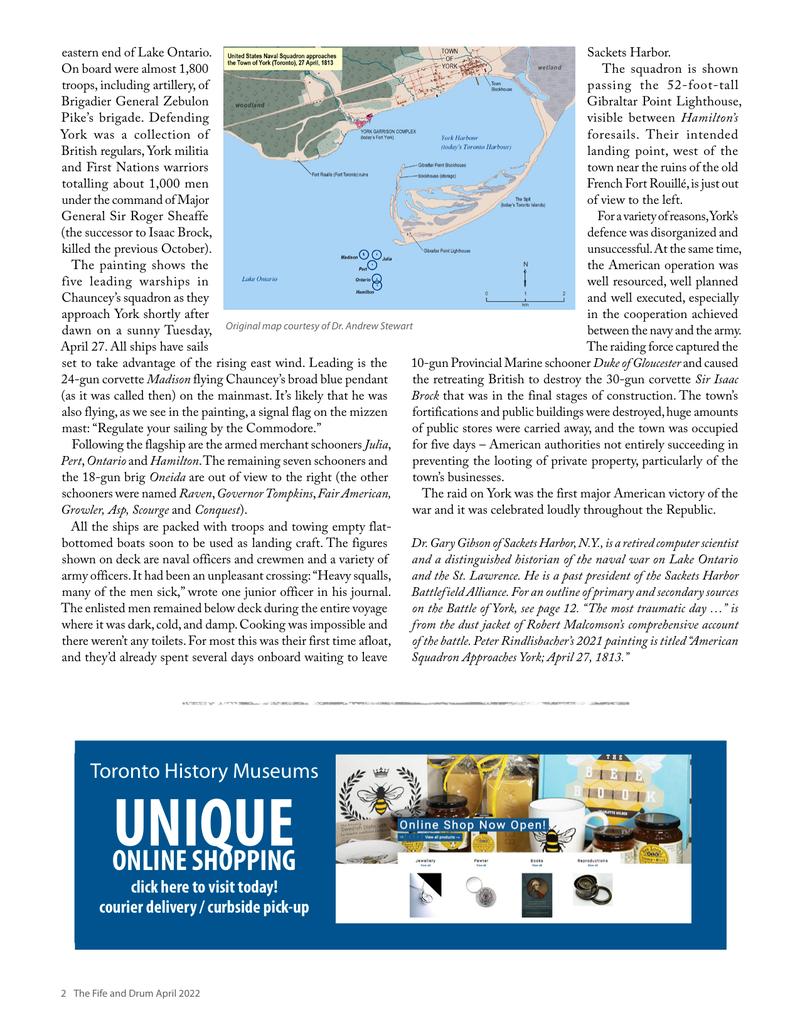
The painting shows the five leading warships in Chauncey’s squadron as they approach York shortly after dawn on a sunny Tuesday, April 27. All ships have sails set to take advantage of the rising east wind. Leading is the 24-gun corvette Madison flying Chauncey’s broad blue pendant (as it was called then) on the mainmast. It’s likely that he was also flying, as we see in the painting, a signal flag on the mizzen mast: “Regulate your sailing by the Commodore.”
Following the flagship are the armed merchant schooners Julia, Pert, Ontario and Hamilton. The remaining seven schooners and the 18-gun brig Oneida are out of view to the right (the other schooners were named Raven, Governor Tompkins, Fair American, Growler, Asp, Scourge and Conquest).
All the ships are packed with troops and towing empty flat-bottomed boats soon to be used as landing craft. The figures shown on deck are naval officers and crewmen and a variety of army officers. It had been an unpleasant crossing: “Heavy squalls, many of the men sick,” wrote one junior officer in his journal. The enlisted men remained below deck during the entire voyage where it was dark, cold, and damp. Cooking was impossible and there weren’t any toilets. For most this was their first time afloat, and they’d already spent several days onboard waiting to leave Sackets Harbor.
The squadron is shown passing the 52-foot-tall Gibraltar Point Lighthouse, visible between Hamilton‘s topsails. Their intended landing point, west of the town near the ruins of the old French Fort Rouillé, is just out of view to the left.
For a variety of reasons, York’s defence was disorganized and unsuccessful. At the same time, the American operation was well resourced, well planned and well executed, especially in the cooperation achieved between the navy and the army.
The raiding force captured the 10-gun Provincial Marine schooner Duke of Gloucester and caused the retreating British to destroy the 30-gun corvette Sir Isaac Brock that was in the final stages of construction. The town’s fortifications and public buildings were destroyed, huge amounts of public stores were carried away, and the town was occupied for five days — American authorities not entirely succeeding in preventing the looting of private property, particularly of the town’s businesses.
The raid on York was the first major American victory of the war and it was celebrated loudly throughout the Republic.
In a small pocket diary, William Beaumont describes the voyage to York. It is clear that only a few persons in the American force knew their eventual destination:
24th A.M. Put out of harbor with a fair wind, tho mild and pleasant the fleet sailing in fine, affording a very pleasant scene thro the day.
25th, 6 Ock, [o’clock] A.M. Morning most delightful. Wind fresh and increasing, not fair, obliging us to beat. Getting along slowly.
26th, Wind pretty strong in the morning, increasing to a strong blow, so that the swells were high, tossing our vessels smartly about. Several seasick – was myself. At half-past four o’clock passed by the mouth of the Niagara River. This circumstance baffled our imagination where we were going. We were first impressed with the idea of Kingston, then to Niagara, but now our destination must be Little York. At sunset came in view of York Town and the Fort, where we lay all night within three or four leagues.
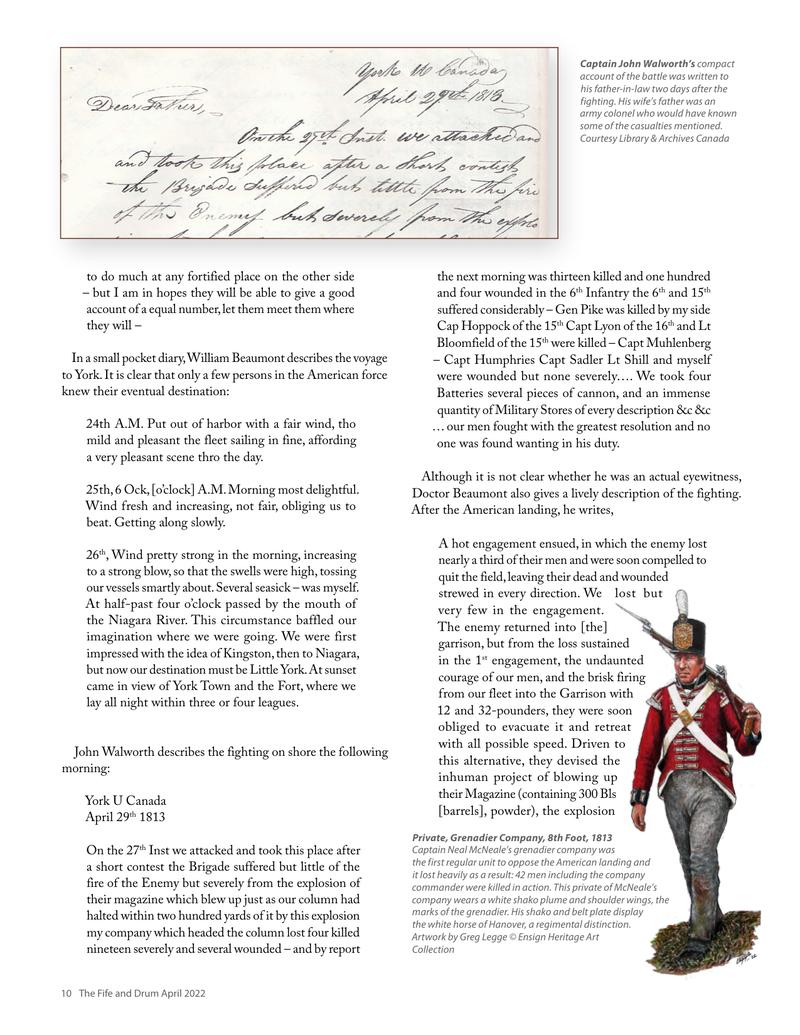
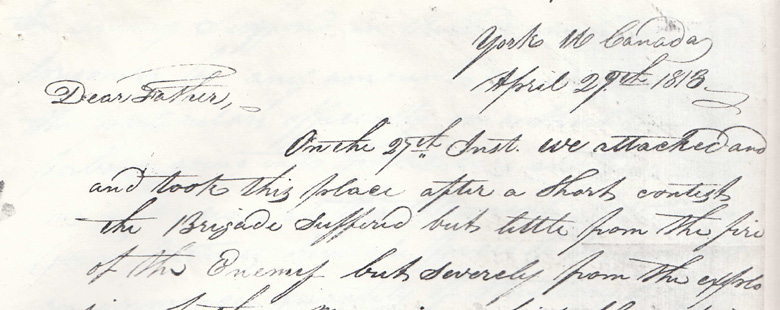
John Walworth describes the fighting on shore the following morning:
York U Canada
April 29th 1813On the 27th Inst we attacked and took this place after a short contest the Brigade suffered but little of the fire of the Enemy but severely from the explosion of their magazine which blew up just as our column had halted within two hundred yards of it by this explosion my company which headed the colum lost four killed nineteen severely and several wounded – and by report
the next morning was thirteen killed and one hundred and four wounded in the Infantry the 6th and 15th suffered considerably – Gen Pike was killed by my side Cap Hoppock of the 6th Capt Lyon of the 16th and Lt Bloomfield of the 15th were killed – Capt Muhlenberg – Capt Humphries Capt Sadler Lt Shill and myself were wounded but none severely…. We took four Batteries several pieces of cannon, and an immense quantity of Military Stores of every description &c &c … our men fought with the greatest resolution and no one was found wanting in his duty.
Although it is not clear whether he was an actual eyewitness, Doctor Beaumont also gives a lively description of the fighting. After the American landing, he writes,
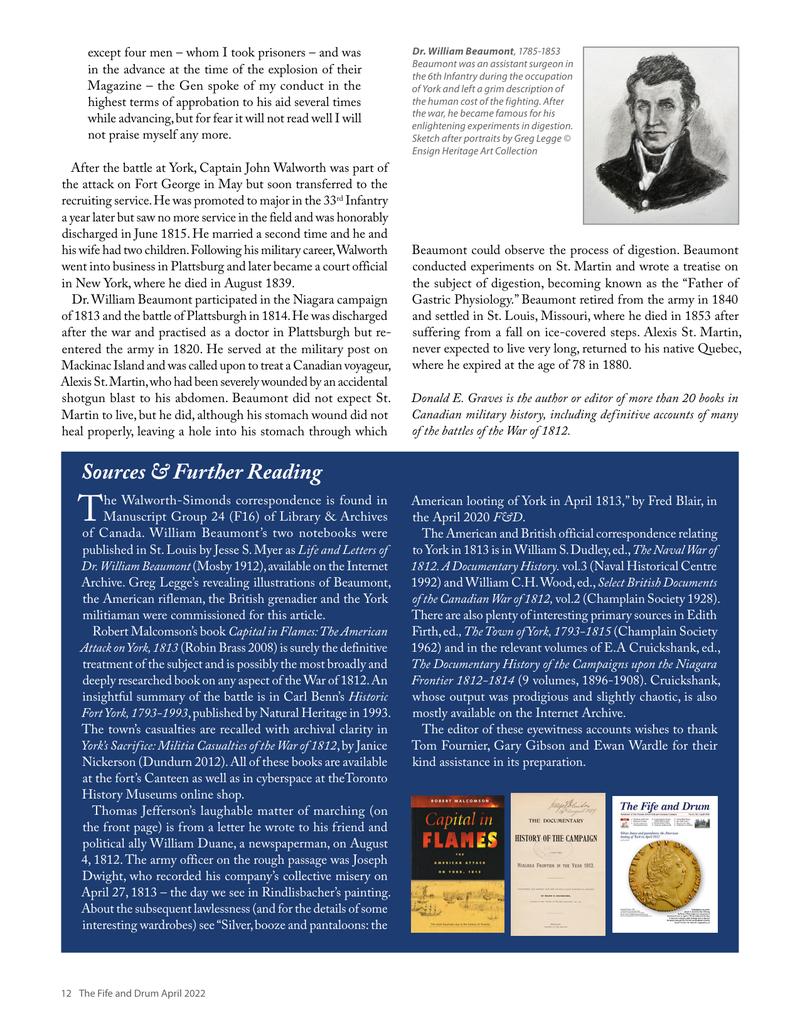
A hot engagement ensued, in which the enemy lost nearly a third of their men and were soon compelled to quit the field, leaving their dead and wounded strewed in every direction. We lost but very few in the engagement. The enemy returned into [the] garrison, but from the loss sustained in the late engagement, the undaunted courage of our men, and the brisk firing from our fleet into the Garrison with 12 and 32-pounders, they were soon obliged to evacuate it and retreat with all possible speed. Driven to this alternative, they devised the inhuman project of blowing up their Magazine (containing 300 Bls [barrels], powder), the explosion
except four men – whom I took prisoners – and was in the advance at the top of the wall of their Magazine – the Gen spoke of my conduct in the highest terms of approbation to his aid several times while advancing, but for fear it will not read well I will not praise myself any more.
After the battle at York, Captain John Walworth was part of the attack on Fort George in May but soon transferred to the recruiting service. He was promoted to major in the 33rd Infantry a year later but saw no more service in the field and was honorably discharged in June 1815. He married a second time and he and his wife had two children. Following his military career, Walworth went into business and became a town official in New York, where he died in August 1839.
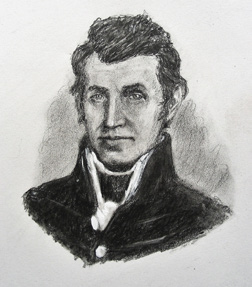
Dr. William Beaumont participated in the Niagara campaign of 1813 and the battle of Plattsburgh in 1814. He was discharged after the war and practised as a doctor in Plattsburgh, but re-entered the army in 1820. He served at the military post on Mackinac Island and was called upon to treat a Canadian voyageur, Alexis St. Martin, who had been severely wounded by an accidental shotgun blast to his abdomen. Beaumont did not expect St. Martin to live, but he did, although his stomach wound did not heal properly, leaving a hole into his stomach through which Beaumont could observe the process of digestion. Beaumont conducted experiments on St. Martin and wrote a treatise on the subject of digestion, becoming known as the “Father of Gastric Physiology.” Beaumont retired from the army in 1840 and settled in St. Louis, Missouri, where he died in 1853 after suffering from a fall on ice-covered steps. Alexis St. Martin, never expected to live very long, returned to his native Quebec, where he expired at the age of 78 in 1880.
Sources & Further Reading
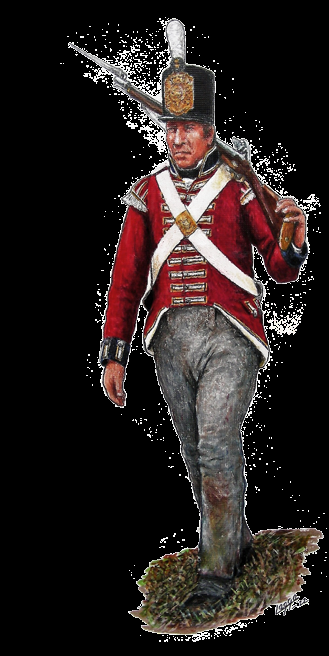
The Walworth-Simonds correspondence is found in Manuscript Group 24 (F16) of Library & Archives of Canada. William Beaumont’s two notebooks were published in St. Louis by Jesse S. Myer as Life and Letters of Dr. William Beaumont (Mosby 1912), available on the Internet Archive. Greg Legge’s revealing illustrations of Beaumont, the American rifleman, the British grenadier and the York militiaman were commissioned for this article.
Robert Malcomson’s book Capital in Flames: The American Attack on York, 1813 (Robin Brass 2008) is surely the definitive treatment of the subject. It’s an outstanding and very deeply researched book on any aspect of the War of 1812. An insightful summary of the battle is in Carl Benn’s Historic Fort York, 1793-1993, published by Natural Heritage (1993). The town’s casualties are recited with archival clarity in Nick Baxter-Moore’s Military Casualties at York 1813 (Inglis Press) by James Nickerson (Dundurn 2012). All of these books are available at the fort’s Canteen as well as in the bookstore at Toronto History Museums online shop.
Thomas Jefferson’s laughable matter of marching (on front-page page) is from a letter he wrote to a friend and political ally William Duane, a newspaperman, on August 4, 1812. The army officer on the rough passage was Joseph Dwight, who recorded his company’s collective misery on April 27, 1813 — the day we see in Rindlisbacher’s painting. About the subsequent lawlessness (and for the details of some interesting wardrobes) see “Silver, booze and pantaloons: the American looting of York in April 1813,” by Fred Blair, in the April 2020 F&D.
The American and British official correspondence relating to York is found in Bk 3 in William S. Dudley, ed., The Naval War of 1812. A Documentary History, vol. 3 (Naval Historical Centre 2002) and in William C.H. Wood, ed., Select British Documents of the Canadian War of 1812, vol.2 (Champlain Society 1928). There are also plenty of interesting primary sources in Edith Firth, ed., The Town of York, 1793-1815 (Champlain Society 1962) and in the relevant volumes of E.A Cruickshank, ed., The Documentary History of the Campaign upon the Niagara Frontier 1812-1814 (9 volumes, 1896-1908). Cruicksh
Original printed pages